
DI Fundraiser with Ten Thousand Villages
The Dialogue Institute is excited to announce a special fundraiser in partnership with Philadelphia-area Ten Thousand Villages stores on Tuesday, December 15, 3-7 pm.

Ardmore: Suburban Square
32 Parking Plaza, Suite 104
Center City: 1122 Walnut Street
Chestnut Hill: 8331 Germantown Avenue
King of Prussia: The Court at King of Prussia Mall
690 West Dekalb Pike, Suite 2098
Media: 101 West State Street
The Dialogue Institute is excited to announce a special fundraiser in partnership with Philadelphia-area Ten Thousand Villages stores on Tuesday, December 15, 3-7 pm.
If you live in or near Philadelphia, you can do your holiday (or other) shopping at any of five local stores (see list to the right) and help support the Dialogue Institute while you're at it! Ten Thousand Villages will donate 15 percent of all in-store sales during that time period - from all five stores - to the Dialogue Institute. Representatives from the DI will also be on hand to share information and answer questions, so please stop by and say hello.

WE NEED YOUR HELP! To make the most of this unique opportunity, please save the date and make plans to do some shopping on Tuesday, December 15, 3-7 pm (please stop by our table and say hello!). And be sure to let any family, friends and colleagues in the area know about it - you can share this post through social media (see Share icon below) and/or download the event flier to share by email or otherwise.
Ten Thousand Villages, one of the world's largest fair trade organizations and a founding member of the World Fair Trade Organization (WFTO), strives to improve the livelihood of tens of thousands of disadvantaged artisans in 38 countries. Ten Thousand Villages is an exceptional source for unique handmade gifts, jewelry, home decor, art and sculpture, textiles, tableware and personal accessories representing the diverse cultures of artisans in Asia, Africa, Latin America and the Middle East.
Living and Learning Religious Diversity in the U.S.
When I told my friends that I would go and stay in the United States for four months, I received everything from congratulations to warnings, and all of these responses made sense to me.

Farinia (Nia) Fianto is a Community Solutions Program fellow from Indonesia, serving as an intern at the DI for the fall semester. She is Managing Director for the International Center for Islam and Pluralism (ICIP) in Jakarta.
Click here to learn more about her!
When I told my friends that I would go and stay in the United States for four months, I received everything from congratulations to warnings, and all of these responses made sense to me. They demonstrated to me the mixed feelings and opinions around the situation in America, particularly dealing with minority groups (Muslims belonging to this category). From the attacks on mosques, Qur'an burnings, anti-Muslim rallies and the recent Chapel Hill shooting tragedy, it's clear that Islam and Muslims are still targets of bigotry, and Islamophobia still happens despite the fact that the U.S. government has taken some action to address it.
To be fair, my knowledge of the U.S. is entirely based on the narrative that I have seen portrayed within movies, books, music and most importantly, the media. My perception before and after the 9/11 tragedy has also changed drastically when it comes to religious freedom and minority rights in the U.S. Before 9/11, I dare to say that I was fond of American culture, and as a matter of fact, I used to have my own version of the "American Dream" where I would travel to the U.S. and learn more about how Americans practice their freedom. However, post 9/11, with the situation drastically changed, my opinion and perception of the U.S. and its people regarding Islam and Muslims has been deeply impacted. I was deeply disappointed by the U.S. invasion in both Afghanistan and Iraq as part of the "War on Terror" campaign,” initiated by then-President George W. Bush.
This situation has massively affected the world, including my own country, Indonesia. Suddenly the word “terrorism” became familiar and people with certain characteristics were suspected as terrorists - the definition and parameters of which are still being debated in Indonesia. In 2002, another sad tragedy known as the "Bali Bombing" occurred, and again Islam and Muslims in Indonesia became a target - accused of spreading the seeds of terrorism. This tragedy somehow has opened eyes for Indonesian Muslims that, on one hand, we could not deny the existence of extremist groups using Islam as a banner to justify their violent actions; and on the other hand, we have an opportunity to step forward proactively in promoting the Indonesian Islam that is more open, tolerant and inclusive.
This paradigm offers another Islamic panorama to the global scene, emphasizing that Islam is very rich and diverse, not represented only by a certain region, such as the Middle East where Islam originated. However, when Barack Obama was elected for the first time as the U.S. President, the world’s citizens (including me) had high hopes that this uncertain political situation would improve and that the wars would end. That moment somehow restored my faith in the U.S. as a large nation that had embraced a positive change, a change which would eventually affect the global political perspective for the better.
Returning to the different kinds of responses I have received from my family and friends, I found out that most of them were happy for me to be able to experience living and working in the U.S. “It is a privilege for you to be able to go there and experience American life,” they said to me, but at the same time, they were also worried that issues like Islamophobia and the related violence that has happened in the U.S. could affect my experience living here.
However, days before my departure, I was also positively advised to manage my expectation about the United States. “Things you have seen and heard about the U.S. are perhaps not entirely accurate in describing America and its people. You need to live and experience yourself, and consider that every single city in the U.S. is not the same.” I did some research on my destination, Philadelphia, as an iconic city where I would live for almost four months, while also working with the Dialogue Institute (DI) through the International Research and Exchanges Board (IREX), an international non-profit program based in Washington D.C. I was selected to join their Community Solutions Program as a fellow in order to improve my leadership potential and broaden my skills to the benefit of my organization, the International Center for Islam and Pluralism (ICIP), and my community in Indonesia.
I have spent almost three months in Philadelphia at this point, and have been working for the DI since mid-August. Based on my living and learning experience here, I have realized that the U.S. and Indonesia have some things in common in terms of diversity and multiculturalism.
Both nations are large countries that have adopted democratic systems and hold similar mottoes; the U.S. has its E Pluribus Unum, derived from the Latin, meaning "out of many;" Indonesia has its Bhineka Tunggal Ika, derived from Sanskrit, meaning "unity in diversity." The two nations' populations consist of various ethnicities, cultures, languages and religions, and share a similar history - the U.S. occupied initially by the British, and Indonesia by the Dutch. Both countries have also struggled for independence and freedom out of a similar context of oppression; the U. S., of course, has embraced its independence since July 4, 1776, while Indonesia gained its independence officially on August 17, 1945.
In its historical journey, the United States is surely richer in terms of civilian experience - including democratic and human rights experience - compared to Indonesia. I have enjoyed my experience of living and learning the diversity and multiculturalism as a Muslim in Philadelphia; as a matter of fact, it has exceeded my expectations. As a Muslim I have no trouble living "normally" like any other Americans who share different faiths than me; and to some extent, I sense that people really do not care about religion. It is true that minority groups like Muslims will still be targets for discrimination, as evidenced by the recent "Clock Kid Incident” in September 2015, where a young teenager named Ahmed Mohamed was arrested at MacArthur High School in Irving, Texas for bringing an alleged hoax bomb to school. The case quickly attracted widespread attention, and most suggested it had something to do with Islamophobia. For me the case is quite interesting; on one hand there is clearly discrimination involved, but on the other hand, the public reaction shows how - in general - Americans are mature enough to support the act against discrimination. I witnessed the public support, including high-ranking politicians and President Obama who strongly supported dropping the charges against Ahmed. For me, it shows that America is mature enough as a nation to stand up against discrimination.
My other remarkable professional experience (so far) came when the DI (along with the International Center for Religion & Diplomacy and Peace Catalyst International), co-sponsored and hosted a national Conference on Religious Freedom and Islamophobia in October. It was attended by around 40 Evangelical Christian leaders from around the U. S. (representing a range of views on Islam) to explore and better understand the consequences of Islamophobia and anti-Muslim bigotry, and develop thoughtful responses to Islamophobia in the United States. Selected Jewish, Muslim (including me) and non-Evangelical Christian representatives also participated to help provide a broader contextual understanding of the issues being addressed. During the conference I met with numerous prominent figures who are committed to create and strengthen harmonious interfaith relations in this country. I am convinced that religious freedom and diversity still have a bright future here in the U.S.A.
My personal experience as a Muslim woman who wears a veil is not strange here. In Philadelphia it is quite common to see Muslim women wearing a veil, and even niqab and burka! That is for me very encouraging considering that Islam is a minority religion here. Even in a predominantly Muslim country like Indonesia, these types of veils are not popularly worn. Being a Muslim in Philadelphia is also relatively easy since there are a number of mosques that openly welcome any visitor to come. As an Indonesian Muslim, my favorite place of worship has been Al Falah, which is run by the Indonesian Muslim community in Philadelphia. Despite the number of Muslim congregations here, Al Falah is relatively small, but it is a solid community and provides an important forum for Indonesian Muslims - and non-Indonesian Muslims - to practice the prayers and observe religious festivals together. Al Falah is also open for non-Muslims to come and participate in interfaith dialogue, as was the case recently, when a group of Mormon bishops from Philadelphia came and had an open discussion with the Muslim community of Al Falah. The bishops left with appreciation for the openness and inclusion expressed by the Al Falah community, and how Indonesian Muslims are different from some other Muslim communities they have visited.
Speaking of Indonesian Muslims in Philadelphia, I hope that the community will be able to speak more loudly about Islam - particularly Indonesian Islam, which has been able to adjust and integrate with American principles and values without losing its identity. The biggest issue for the Muslim community here, in my opinion, is that they need to be more proactive in reaching out to others, especially those who have a negative sentiment toward Islam. The Muslim community here also needs to hold more intrafaith dialogues to address the different cultures and schools within Islam, and work to create a more unified community regardless of the differences. The dialogue is urgently required among all Muslim communities in order to address issues regarding the practice of religious rights. For example, recently the Muslim community in Philadelphia formed the Philly Eid Coalition, inspired by New York City to work for the inclusion of the two Islamic holidays, Eid al Fitr and Eid al Adha, in the City and public school calendars as observed holidays. However, to make a proposal to the City, the coalition will need to resolve the differences in understanding of the "official" dates for these two holy days.
In short, although I have spent only three months living here, I have had a wonderful experience regarding religious diversity. I am impressed by how Americans in general, and Philadelphians in particular, seem to be tolerant, open and welcoming. I am aware that extremism and racism exist in every country, religion and culture, but from what I have experienced and learned while living here, there are ongoing efforts by individuals and civic organizations - including the religious community - to promote and preserve religious freedom and human rights.
After all, isn’t freedom the fundamental value that binds Americans together in the first place?
Reflections from the World's Largest Interfaith Gathering
A dozen persons dressed in white and wearing wings moved in deliberate, slow steps through the halls of the Salt Palace Convention Center in Salt Lake City, Utah. Some played lyre music as the majority simply smiled at those they passed, creating a sense of peace and care befitting the angels. Nearby, the Sikh community generated a moving sense of generosity and hospitality as they served thousands a delicious and free lunch.
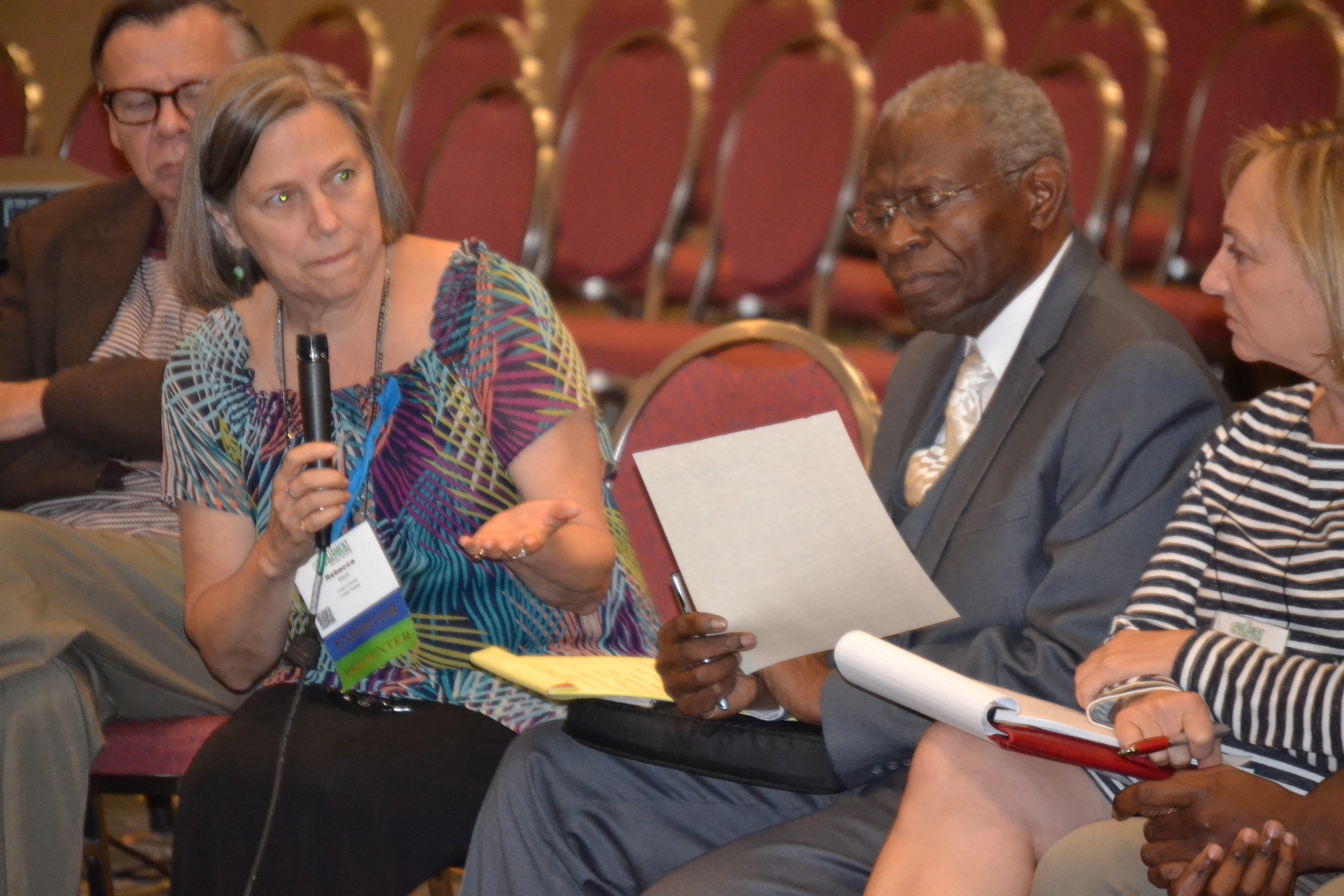
Click above to see additional photos from Parliament.
Rebecca Mays is Executive Director at the Dialogue Institute, and is currently pursuing her Ph.D. in Religion at Temple University. She and DI Founder/President Leonard Swidler led a workshop at Parliament on "Writing a Global Ethic from the Grassroots."
A dozen persons dressed in white and wearing wings moved in deliberate, slow steps through the halls of the Salt Palace Convention Center in Salt Lake City, Utah. Some played lyre music as the majority simply smiled at those they passed, creating a sense of peace and care befitting the angels. Nearby, the Sikh community generated a moving sense of generosity and hospitality as they served thousands a delicious and free lunch.
Over the five days of the Parliament of the World’s Religions—the world’s largest interfaith gathering—some 10,000 people from around the world attended workshops, joined in plenaries, shared in rituals and music, and presented their organizations and wares in the exhibit hall. Workshops and plenaries focused on serious concerns to promote religious understanding and world peace. In one plenary, Tariq Ramadan chastised the large crowd for too much self-indulgent cheering and not enough focus on the issues themselves; plenary issues included climate change, indigenous rights to land, women’s place among religious leadership, economic justice and religious prejudice.
The Dialogue Institute and Journal of Ecumenical Studies served in booth 824 where Leonard Swidler, Tim Emmett-Rardin and I met hundreds of people interested in our work. We were clearly among the “choir”—those people who were convinced of the importance of dialogue, mutual collaboration and service to the poor and uneducated around the globe. KAICIID, the newly formed center for interreligious dialogue in Vienna, Austria, has researched over four hundred organizations who espouse missions similar to the Dialogue Institute's. Len now enjoys the rare experience of knowing his vision of interreligious dialogue formed in the 1950s and 1960s has come of age. We cultivated our relationships with those like-minded folks as we know how critical cooperation will become in the next wave of this movement.
A major gathering on each day of the event pointed to the need for this cooperation and the challenges faced. Each day hundreds gathered with the people who had traveled from the Middle East as members of the Abrahamic Reunion, all working in villages and cities where religious violence threatens daily activities. I found myself again pondering one of the questions that most often comes up with our SUSI (Study of the U.S. Institutes on Religious Pluralism) students from that region and southeast Asia when we explore together the dialogue skill of “agreeing to disagree.”
So what happens after we agree to disagree? In our short five-week study together through SUSI, we strive to maintain respect in building friendships among like-minded young adults. This network of solidarity and support is crucial with this next generation of leaders. But as one Egyptian woman wrote me recently: “I still disagree with (and she named one with whom she had had intense moments of conflict); how can I respect someone with whom I disagree so strongly?” In this reflection I share a partial response to her, and express my gratitude for all those at the Parliament who are working on a response to that fundamental question, on what we do next after we agree to disagree.
My first suggestion is that we create a space, a pause in conversation, time apart, personal reflection—any choice that will allow the mind and heart some room to consider exactly what the disagreement is about. Can we let go of a need to blame or even to hide blame in strident analyses of cause and effect? Instead, in the space we make for reflection where no one is to blame, can we name with compassion those influences that are shaping the disagreement?
In one Parliament workshop, I observed as two passionate parties entangled their perspectives. As sparks began to fly, a third participant simply jumped in to pile on another perspective, everyone hoping the sparks would not derail the workshop. What was needed was this more apophatic space in which a deeper listening to self and to other could happen. Such space is unconventional in a set of assumptions about leadership that emphasizes assertive action, cheers bravado as courage, and values speech over silence. Pregnant pauses of silence can actually birth more real leadership: a new insight, an unforeseen ally, a deeper peace in the belly to precede the next action.
In our dialogue work with young adults, two skills—sides of the same coin—foster understanding that allows for differing opinions to stand side by side. The power of reflective listening is a skill to be practiced over and over again in the space created by silence or reflection. Here is an example of that power.
We were discussing the difficult issue of lesbian and gay rights in a majority culture that disagrees with the practice; I noticed the resistance of our conservative community members. Afterwards I created a space for them to reflect on all they had heard. I had each of them take turns to reflect exactly what they heard the others saying. They shared of their confusion in liking the people; yet, knowing they could not condone the practice of gay and lesbian relationship. I encouraged them to write down more of their own thinking, in their own language, and to keep reflecting each other’s opinions to one another. A few days later a young woman from Turkey came to me to say she was surprised by a connection that had come to her. She had fought for the right to wear her headscarf as her choice; could the fight of gays and lesbians be comparable as a right of choice? She thought so and said she felt humbled by her original views; she still, though, had to think more on an opinion, but she felt she had come to understand “the other” a bit better. Now she wanted to reflect on whether all rights were equal, but she was clear individual choice mattered. She acknowledged how grateful she was for “friends” with whom she had this chance for reflecting and thinking freshly and safely.
In the process, however, the other skill is needed. I observed the resistance in the students in the story above and tried to create a safe space for them. Individuals in a community, especially future leaders, need to recognize in themselves what we have called “red flags” or “boundaries.” To speak up for one’s self without defense or rancor requires trusting that one’s resistances to something someone else is doing or saying are OK. Only then can the fear and/or conviction beneath a resistance be slowly revealed, and allowed to teach. Again, space of place and time are essential components to allow for the permission to raise a “red flag” or name “a boundary;” then with the reflection described above, people can allow fresh perceptions to grow and to flourish.
At Parliament I did at times wonder whether it wouldn’t be more productive for peace and justice to flourish were all the 10,000 people present to remain in their neighborhoods pursuing the work on the ground, where it will make the most difference. And yet, as I observed so much learning, hospitality, cooperation and plans for pending action, I felt uplifted and happy to be with so many I know will return home refreshed and ready to re-engage where needed.
Now back in Philadelphia, I am one of them.
In the News & In Other News
IN CASE YOU MISSED IT:
- DI staff led a lively workshop - called Dialogue Across Difference: Skills for Peacemaking & Global Citizenship - for about 20 participants on September 17. The workshop was featured as part of both Global Philly 2015 and Peace Day Philly events around the city.

IN CASE YOU MISSED IT:
- Be sure to check out our new web feature - DI in the News - featuring examples of the DI's more newsworthy efforts!
- DI staff led a lively workshop - called Dialogue Across Difference: Skills for Peacemaking & Global Citizenship - for about 20 participants on September 17. The workshop was featured as part of both Global Philly 2015 and Peace Day Philly events around the city. Contact Rebecca Mays to learn more about scheduling a workshop or training for your community/organization!
- The DI also co-sponsored, along with the International Center for Religious & Diplomacy and Peace Catalyst International, a national conference on Religious Freedom & Islamophobia, October 6-8.
COMING UP:
- DI staff are busy preparing for our next Study of the U.S. Institute (SUSI) for Student Leaders on Religious Pluralism, January 9 - February 13. Twenty students from Southeast Asia will be participating in the five-week program.
- The Fall issue of the Journal of Ecumenical Studies is due out in early December. Click here to subscribe for 2016!
- Look for our next e-newsletter in mid-February!
DI Hosts "Dialogue Across Difference" Workshop
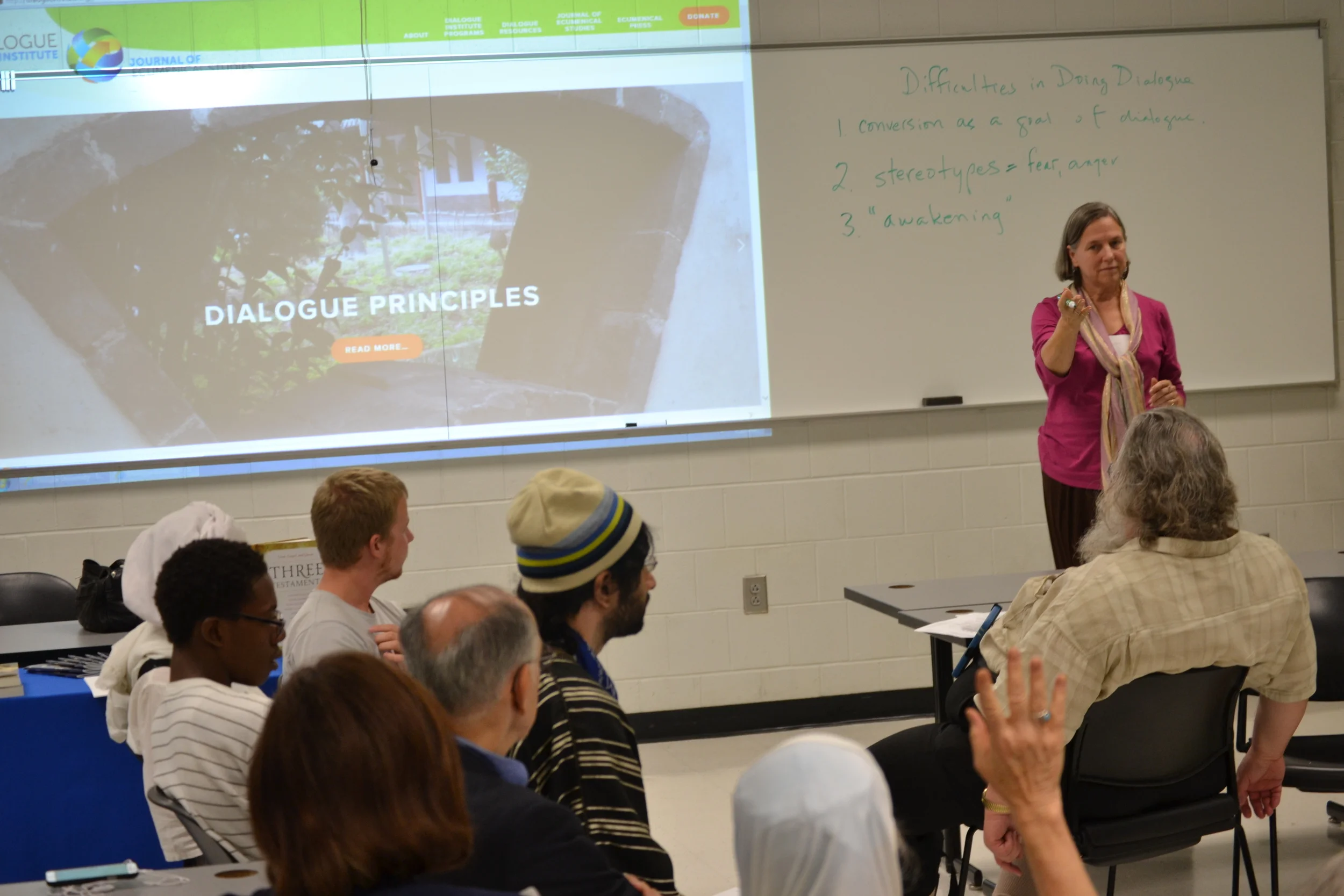
As part of both Global Philly 2015 and Peace Day Philly events across the Philadelphia area, the Dialogue Institute hosted a free introductory workshop, Dialogue Across Difference: Skills for Peacemaking and Global Citizenship, on September 17, 2015.
* click here to see article in The Temple News
Click above to see additional pictures.
As part of both Global Philly 2015 and Peace Day Philly* events across the Philadelphia area, the Dialogue Institute (DI) hosted a free introductory workshop, Dialogue Across Difference: Skills for Peacemaking and Global Citizenship, on September 17, 2015.
In this interactive workshop, DI Founder/President Leonard Swidler and Executive Director Rebecca Mays introduced the nearly 20 participants to Professor Swidler's Dialogue Principles as an essential tool for both peacemaking and global citizenship in any context. Participants ranged from Temple undergraduate students to members of an international peace delegation traveling with The International Sufi School.
For more information about Dialogue Institute trainings/workshops, contact Rebecca Mays at rkm@dialogueinstitute.org or 215.204.7520.
* Global Philly 2015 is an exposition of all things international in Philadelphia, presented by the Global Philadelphia Association. Peace Day Philly is an annual event related to International Day of Peace, officially observed on September 21 worldwide.
DI Welcomes Intern from Indonesia
The Dialogue Institute is pleased to welcome Farinia Fianto, a Community Solutions Program fellow from Indonesia, who will be serving as an intern for the fall semester.

The Dialogue Institute (DI) is pleased to welcome Farinia Fianto, a Community Solutions Program fellow from Indonesia, who will be serving as an intern for the fall semester.
Farinia comes to the DI with a wealth of training and experience. She is currently and has been since 2003 Managing Director for the International Center for Islam and Pluralism (ICIP) in Jakarta, where she designs, develops, implements and evaluates all of ICIP’s programs. She is fluent in Indonesian and English, with additional proficiency in Arabic, Dutch and Javanese. After completing undergraduate studies at Universitas Indonesia, she received her M.A. in Islamic Studies from Leiden University in the Netherlands.
"The Dialogue Institute is one of the leading organizations promoting interfaith dialogue, which is very relevant to my work in Indonesia," says Farinia, who is also the mother of two young daughters, Shirin and Leia. "I am so inspired by the work that has been done by the DI, and it is a great privilege for me to work with an organization like this.
"Hopefully when I return to Indonesia, my experience here will contribute to a significant change in my work and in my community."
Among other responsibilities, Farinia will be helping to expand and deepen engagement with and among the more than 200 alumni of the DI's Study of the U.S. Institutes (SUSI) in an effort to better track program impact and offer ongoing support as they carry out projects in their home contexts.
The Community Solutions Program, run jointly by IREX, an international nonprofit organization, and the Bureau of Educational and Cultural Affairs of the U.S. Department of State, "is a professional development program for the best and brightest global community leaders working in the fields of transparency and accountability, tolerance and conflict resolution, environmental issues and women’s issues." In 2014, 50 different organizations in 21 U.S. states and the District of Columbia hosted 53 leaders from 31 different countries through the program.
Swidler at Nostra Aetate Conference in October
DI Founder and President Leonard Swidler will be one of the featured panelists at the upcoming conference, Nostra Aetate and the Future of Interreligious Dialogue, October 11-13, 2015, at the University of Wisconsin in Madison.

DI Founder and President Leonard Swidler will be one of the featured panelists at the upcoming conference, Nostra Aetate and the Future of Interreligious Dialogue, October 11-13, 2015, at the University of Wisconsin in Madison.
Professor Swidler will participate in the final panel of the conference, titled "Nostra Aetate and the Future." He has devoted much of his scholarly and personal life to the explication and development of the new directions and wider Christian thought within the Roman Catholic Church set forth at Vatican II. Professor Swidler has written extensively on reform within the Catholic Church, fully a third of his 70-plus published books, including Freedom in the Church (1969), Women Priests: Catholic Commentary on the Vatican Declaration (1977), A Catholic Bill of Rights (1988), and the more recent Democratic Bishops for the Roman Catholic Church (2011).
The conference is sponsored by the Lubar Institute, working "to create better understanding of the Abrahamic traditions and their interrelationships by encouraging ongoing discussion of these traditions." To mark the Declaration’s fiftieth anniversary, the conference will reflect upon the global significance of Nostra Aetate, examining its past—and potential future—from multiple perspectives, primarily from outside the Roman Catholic Church. Plenary speakers include the Most Revered Blase J. Cupich, Archbishop of Chicago, and Dr. Paul Knitter, Professor Emeritus at Union Theological Seminary.
The conference is free and open to the public.
DI Staff to Lead Workshop at Parliament of the World's Religions
Dialogue Institute Founder and President, Leonard Swidler, and Executive Director, Rebecca Mays, will lead a workshop at the 2015 Parliament of the World's Religions, October 15-19, 2015, on "Writing a Global Ethic from the Grassroots."

Dialogue Institute Founder and President, Leonard Swidler, and Executive Director, Rebecca Mays, will lead a workshop at the 2015 Parliament of the World's Religions, October 15-19, 2015, on "Writing a Global Ethic from the Grassroots."
The workshop will first present a global ethic written by Professor Swidler for the 1993 Parliament of the World's Religions in Chicago, which has been used and revised in countless communities around the world. Participants will outline an initial draft ethic based on their own experience and contexts, and will be encouraged to continue to discuss and refine the draft in their home communities.
In addition to the workshop, the DI will have an exhibition booth throughout the Parliament (#824), as well as book signings with Professor Swidler each day of the Parliament (Friday-Monday, 12:30-1:30 pm at the exhibition booth, and Saturday, 5-6 pm, following the workshop).
For more information about the Parliament, including registration information: parliamentofreligions.org.
DI Co-Sponsors Interfaith Youth Forum in Indonesia
The Dialogue Institute is proud to have co-sponsored the 4th Interfaith Youth Forum, held in Surabaya, Indonesia, August 7-11. This year's theme was "Rujak: Harmony in Diversity."

The Dialogue Institute is proud to have co-sponsored the 4th Interfaith Youth Forum, held in Surabaya, Indonesia, August 7-11. This year's theme was "Rujak: Harmony in Diversity." Click here to see the full report.
The Forum, started by alumni from the DI's Study of the U.S. Institutes (SUSI) for Student Leaders on Religious Pluralism, is a now-annual event for Indonesian young leaders focusing on building their capacity with respect to tolerance and interfaith dialogue.
The first Forum was held in Palembang in 2012, the second in Bali in 2013, and last year's was held in Palangkaraya, Central Kalimantan.
DI Wraps Up 10th SUSI on Religious Pluralism
The Dialogue Institute concluded its 10th Study of the U.S. Institute (SUSI) for Student Leaders on Religious Pluralism in the United States on August 9, with a final session in Washington, D.C. Twenty students from the Middle East (Egypt, Iraq, Lebanon and Turkey) returned to their home countries following an intensive five-week program focused on religious pluralism and democracy - including four weeks in Philadelphia and a week-long study tour in Atlanta, North Carolina and Washington, D.C.

Click above to see additional photos from Summer SUSI 2015.
The Dialogue Institute (DI) concluded its 10th Study of the U.S. Institute (SUSI) for Student Leaders on Religious Pluralism in the United States on August 9, with a final session in Washington, D.C. Twenty students from the Middle East (Egypt, Iraq, Lebanon and Turkey) returned to their home countries following an intensive five-week program focused on religious pluralism and democracy - including four weeks in Philadelphia and a week-long study tour in Atlanta, North Carolina and Washington, D.C.
They join a group of more than 200 alumni who have participated in the DI's SUSI program since 2010.
"It is such a privilege to work with these courageous and intelligent global young adult leaders," said Rebecca Mays, DI Executive Director and SUSI Co-Academic Director. "We look forward to supporting them as they apply what they've learned about dialogue and religious pluralism in their home contexts."
The program, run jointly by the Dialogue Institute and the International Center for Contemporary Education, with funding from the U.S. Department of State (Bureau of Educational and Cultural Affairs), introduces students from the Middle East and Southeast Asia to central elements of U.S. history, society, institutions, and democracy through a focus on American religious freedom.
The DI will host its next SUSI, January 9-February 13, 2016, with 20 students from Southeast Asia.
SUSI in the News:
- Interview with two of our SUSI students (Karim Zughaib, a Christian from Lebanon, and Somaya Arab, a Muslim from Egypt) on The Nick Taliaferro Show, WURD - 900 AM (July 13, 2015)
- Article in the Jewish Exponent (August 6, 2015)