

A Dialogue with Health Care Providers on Navigating Religious Diversity
PANELISTS
Dr. Devan Stahl, PhD - Assistant Professor of religion and bioethics at Baylor University and former hospital chaplain and clinical ethicist
Dr. Renee Fennell, RN, DMD - President of Dental First Corp. and Adjunct Professor at Temple University’s Kornberg School of Dentistry
Dr. Bijan Etemad, MD - Clinical Associate Professor of Psychiatry at the University of Pennsylvania and practicing Psychiatrist with over 60 years of experience
EVENT DESCRIPTION
To many, it would seem that religion has no place in medicine. Yet, since before the time of Hippocrates in the fifth century, the popular belief was that the gods caused as well as cured human diseases. Hippocrates is considered the Father of Modern Medicine and since his time Western societies began to believe that natural forces like the cosmos and an imbalance of the four humours caused disease. Although, western medical practices today are shaped more by science, religious views still have a strong influence for many people and what they expect from caregivers. As a result, religious literacy and the skills of dialogue are essential for medical caregivers. Join us for a dialogue centered on the relationship between religion and medicine and hear our panelist’s personal experiences of navigating diverse religious orientations among their patients.
Event Transcript from November 15, 2021
David Krueger: Good afternoon, everyone. On behalf of the Dialogue Institute at Temple University in Philadelphia, the United States, I'd like to welcome you to this zoom panel discussion titled Religion and Medicine, a Dialogue with Health Care Providers on Navigating Religious Diversity. This afternoon we have experts from around the region and around the U.S. that will be contributing to what will no doubt be a fascinating discussion about the role that dialogue and religious literacy plays in providing health care in communities. So if you don't mind I'd like to share just a little bit of an introduction to the Dialogue Institute in case this is an organization that is new to you.
The mission of the Dialogue Institute is to engage religious, civic, and academic leaders in practicing the skills of respectful dialogue and critical thinking, building and sustaining transformative relationships across lines of religion and culture. It provides resources and creates networks for intra- and inter- religious scholarship and action that value difference and foster human dignity.
Established in 1964, the peer reviewed Journal of Ecumenical Studies advances critical awareness of the latest directions and ecumenical and interreligious research and, of course, our Journal of Ecumenical Studies is open for submissions and also open for book reviewers if you are so inclined. Be sure to visit our website to learn a bit more about our programming.
Some of the key programs we run include our Study of the US institutes on religious pluralism. This is a program that runs in collaboration, and with the support, of the US State Department, where we host international groups from around the world, both young adults and older adults, in programs that teach literacy and understanding of religious difference, discuss the origins of democracy in the United States, and teach the skills of dialogue and leadership to be applied in home settings. We also have a new program over the past year, in partnership with Citizen Diplomacy International where we train young innovators in social innovation and stem innovation, and training them and equipping them with the skills of dialogue and cross cultural understanding and communication. We are also running a tours program, highlighting religious diversity and pluralism in the city of Philadelphia and beyond. You can sign up if you want to take a virtual or in person tour on the streets of Philadelphia and beyond. Lastly, we also have a new program that facilitates dialogue and understanding between African Americans and Jews in Philadelphia, we have a partnership with a documentary film, and we're looking to expand our programming in these areas as well. So we're excited today, because this is a program that really gets to the core of the work that we do; advancing understanding across religious differences, helping people to be equipped to understand and to work across differences, and number two, to also to be focusing on the skills of dialogue- how can we apply dialogue to everyday life. So without further ado I'm going to turn it to a recent Temple University Department of Religion graduate, Heidi Isaac who will assist us with some conceptual framing and set a foundation for our conversation today. Heidi?
Heidi Isaac: Thank you, Dave. I would like to just say a few words before our panelists get started sharing their experiences. So, personally, I know that medicine was developed through the study of religion, yet I have encountered numerous individuals who do not know the connection, and importance, of having a religious studies background in the medical field. So I'd like to say a few words about that.
In the fifth century BC Hippocrates, often remembered as the father of modern medicine, recognized the body's natural ability to heal itself. He even instructed physicians to find blockage within patients and between them and the cosmos when attempting to heal them. Hippocrates’ formal name was Hippocrates Asclepiades, which meant “descendant of (the doctor-god) Asclepios.” Before Hippocrates, people believed that the gods caused human diseases. Through Hippocrates practices and teachings, which are recorded in the oldest medical books, more than 60 books collectively known as the Hippocratic Corpus, the belief that natural forces caused diseases became the new popular belief. The Hippocratic Corpus was completed 100 years after Hippocrates’ death by many different physicians during his time that are believed to share the same basic assumptions Hippocrates had about the human body, how it works, and the nature of disease. The medical practices found in the Corpus lead to the creation of the Hippocratic Oath.
The Hippocratic Oath, as many know it today, is a document on medical practices, ethics, and morals. However, the oath that medical graduates take today at the start of their career is not the original one of the 5thcentury BCE. The original oath starts off by mentioning 4 Greek gods, yet today, it may seem that religion is removed from medicine altogether. In fact, physicians are told not to let their own religious views affect how they practice medicine. Physicians are supposed to not let their religious views control their decisions, yet it is not uncommon for a patient to choose the medical practices that best agree with their religion. Therefore, we here at the Dialogue Institute strongly believe that having knowledge of religious pluralism would be highly beneficial in the medical field- that it would lead to better care for the patients and their family, insure all the needs of a patient are met, avoid any unnecessary, added stress to the patient and their family, and reduce the number of lawsuits against physicians and hospitals.
Two years ago, our editor-in-chief of the Journal of Ecumenical Studies, Dr. Terry Rey, and his late wife, Maria Rey, a former medical interpreter at CHOP, wrote an editorial for our 54:3 issue. In it, they each provide a personal case study where religious illiteracy had detrimental outcomes for the patients and hospitals. They make the case that training in religious literacy should be provided to all health care providers, especially in a large, ethnically, and religiously diverse country like the United States. The United States attracts patients and families from every other continent, each coming with their own set of religious beliefs and practices. Rey and Rey discuss the consequences that arise from misunderstanding such beliefs and practices and call for hospital professionals to “be conversant with the religious-based values of the traditions that they are most likely to encounter on any given day.” You can read their article in full in our summer 2019 issue, but now we will turn things over to our honored panelists who will be sharing their experiences regarding the following questions:
We know that in the past, religious and moral narratives informed our understandings of illness and disease. Does this still hold true today? What are some of the challenges that health care providers face in practicing medicine in a multi-religious, multicultural environment? And, have there been instances where your patient's religious views have restricted or influenced how you have provided care to them?
First we will hear from Dr. Devan Stahl, an Assistant Professor of Religion and Bioethics at Baylor University. Dr. Stahl has taught bioethics to undergraduates, medical students, nursing students, veterinary students, and residents. She also worked as a hospital chaplain and as a clinical ethicist in hospitals. Her interests include medicine, theological bioethics, disability studies, and end of life issues.
Next, we have Dr. Renee Hamdiyah Fennell, the president of Dental First Corp. and is involved with Temple University Kornberg School of Dentistry’s Diversity Office. Dr. Fennell was a registered nurse before she started practicing dental medicine and uses both trainings to educate the community about the connection between oral and systemic health. She is working on a book titled “Oral Health, The Gateway to a Healthy Heart!”
Our third panelist for today is Dr. Bijan Etemad, a Clinical Associate Professor of Psychiatry at the University of Pennsylvania, as well as a practicing Psychiatrist. When it comes to patient care, Dr. Etemad has the most experience among our guests this afternoon, over 60 years of it. Dr. Stahl, would you like to start us off?
Devan Stahl: Hello everyone. Thanks for having me. I'll keep these remarks brief, so we can get into lots of good questions and answers. So when we think about the landscape of religion and medicine it's easy to think now that there's an easy separation between the two, the medical sciences rely on fact and religion relies on belief. But of course it's not that simple. A lot of my research is on how theological ideas influenced medical practice in earlier centuries, as Heidi was just saying, particularly in the West. There's no question that for most of recorded history there was a strong alliance between medicine and religion. Natural philosophers, who today we call scientists, were concerned with discovering who God was through learning more about the human body and the natural world. These physician philosophers were considered secular theologians, meaning they thought about theology not as ministers of the Church, but as people who taught and thought about the natural world.
In fact, against the myth that religion and science have always been opposing discourses, it was religious belief in God, that God could be known through studying the natural world, that fueled the scientific revolution of the modern era.
Now, since that time medicine has really pulled away from its reliance on theology and any particular understanding of God, so the scientific method itself doesn't necessarily rely on theological premises. However, in many parts of the world, including in this country, we still have a significant number of people who consider themselves religious. Their understanding of illness is shaped by their religion and their engagement with medicine is also influenced by their religious beliefs. Study after study shows that people make medical decisions based upon their religious beliefs. Now sometimes this is obvious, like when a Jehovah's witness refuses a blood transfusion, or when a Christian scientist believes that prayer alone will cure their disease.
When I was a chaplain it wasn't uncommon for patients to ask me to pray that they would receive a miraculous cure, or that God would guide their physicians to affect a cure, but beliefs can act more subtly too; influencing people's trust in medicine or their physicians, the spiritual distress they may experience as a result of illness, or the coping mechanisms they use to get them through illness. Religion remains pervasive in the patient imagination, as well as for some of our medical professionals. The diversity of religious belief in our country presents particular challenges for clinicians, however. I fear that many of our clinicians are not trained to have religious conversations.
Even if a clinician is themselves religious, this doesn't necessarily mean they have a basic understanding of the various religious beliefs of their patients, and of course we wouldn't expect them to. I have a graduate degree in religion and I don't understand everything about every religion. In fact, I fear that we're equipping many of our clinicians with just enough knowledge to be dangerous. In other words, we teach them a little bit about different religious worldviews and then they assume they know much more than they do. Or, they forget that belonging to a religion doesn't necessarily mean that a patient adheres to every aspect of their tradition’s beliefs.
Instead, I think we should be teaching our clinicians how to ask the right kinds of questions of patients and to not be afraid when patients present them with very particular religious answers and explanations to their beliefs. We don't want to debate theology with our patients, but we also don't want religious belief to be a conversation stopper, and this can be a delicate balance. So as a clinical ethicist, I've seen it happen many times, where a physician became quite frustrated with a patient when their religious beliefs seem to be driving them to reject medical care, or to request aggressive medical care.
I remember a time when a young mother refused a blood transfusion knowing that she would likely die without it. This created incredible distress on the medical team, who worried that her religious beliefs were coerced, and had a hard time accepting that anyone in their right mind would refuse something as simple as a blood transfusion. Once it was established that the woman did have decision making capacity, and that her decision wasn't coerced, she was allowed to refuse that transfusion and she did die. After that, there was a lot of debriefing that needed to happen with the medical team, so they could better understand her decisions and express their feelings about it.
I've also witnessed and done research on requests for non-beneficial treatment at the end of life in the hopes that a person would receive a miracle. This can be an incredibly frustrating experience for many clinicians because they aren't sure how to talk about religion with these patients, and they feel as though they're going against their professional obligations of beneficence and nonmaleficence to provide treatment that's non-beneficial. This is where I think training on how to talk with patients about their religious beliefs can be incredibly beneficial.
Many patients want to talk about their beliefs with their physicians, but many physicians don't feel equipped to have these conversations. This is where chaplains and ethicists can be tremendously helpful. In many instances I'll bring in religious leaders into family meetings to help guide these conversations, which is not something we would normally do. Now, of course, not every patient will want that, but if religion, and religious authority, is important to a patient, and is helping to direct their medical choices, then this is something the medical care team should take seriously. I don't think that we need to provide any and all medical treatment that a patient requests, simply because they say the request is based on their religious belief, but attending to those beliefs can establish trust and respect with patients, and maybe necessary if we want to find mutually agreeable treatment plans with our patients.
Now all that to say, I think we have a long way to go in training our medical professionals to understand, respect, and converse with patients who hold religious beliefs that they themselves don't hold. So, given the diversity of religious traditions in this country that's no small task. So I hope we can chip away at that a little bit this afternoon. Thank you.
Heidi Isaac: Thank you, Dr. Stahl. Dr. Fennell?
Renee Fennell: Greetings everybody. I'm going to echo Dr. Stahl, and I'm going to come from a position of unconscious bias. From that position of unconscious bias, I'm echoing her to say that it starts in the medical schools, the dental schools, the nursing schools, the pharmacy schools, and everyone, we all have unconscious bias. We actually don't know that we actually have it, but it does rear its head many times. So the real question is, are you aware, or are you not aware. Are you aware that this might be a bias that you might have against religion or any cultural difference that you might have as a practitioner?
The way of teaching cultural competency or religious literacy, you can't learn all the religions, you can't learn every aspect of every religion or every culture. So I think that the key is communication and the key is coming from a humanistic point of view and, like Dr. Stahl said, communication and compassion. If we do communication, passion, and humanistic conversation with our patients and we teach that in the dental schools, medical schools, and all of the schools, we will actually be able to be better practitioners, better instructors, philosophers and everything.
What we find a lot, especially in the western world, is we find ethnocentrism and what ethnocentrism is, is that it's the feeling that your culture, or your religion, or your point of view trump's everybody else's. And so when we're in a space of scientific evidence and our culture, here in the United States, appoints us to scientific evidence, when people come with a religious background or philosophical background, many people will tend to just not honor it, not even hear it, become confused with it, and discredit what the patient is actually saying. The opposite of the ethnocentrism is xenocentrism, and especially with a lot of disenfranchised communities who suffer xenocentrism, where they feel like other people's culture trump's theirs, and so they don't speak up, they don't ask questions. They they just go with what the doctors might be telling them and all of these things, they breed mistrust, they breed misinformation. As practitioners, the more that we can get into with our own bias and the more that we can keep compassion and communication to the forefront, the better that we’ll be able to serve our patients. And one of the ways we can do that is cultural relativism. Cultural relativism will point us in the direction where we understand we have a bias and, just like the example that Dr. Stahl gave, would be Jehovah’s witnesses and the lack of taking transfusions. We don’t understand it, but we're able to accept it because we now know that people think a little bit differently than we do.
And so I'm going to close by just talking about a few of my own patients. I have patients from all walks of life and so many times I think to myself why are they coming to me when they could go to their Buddhists, Jewish, or holy leader. Why do they come to me? And I think that they do because we don't judge ,we don't judge, and we also actually just listen. And so the communication of listening and asking the right questions so that patients can tell us things like, “We don't like to take the blood transfusion,” or for me, it will be I hear things like, a big one, which we're going to discuss later, is the vaccine. Why people don't want to take the vaccine. Why Muslim women only want to be seen by Muslim women doctors, for the most part.
As we go about this whole conversation today, I would like to ask each of us to just think about our own unconscious biases that we may have. I have to think about them all the time. I have patients that have tattoos from the top of their heads, to the bottom of their toes and they're afraid of a needle, and I just sit there and think to myself you've been pricked, and pricked, and pricked, but you're definitely afraid of this anesthesia that you're going to get today. So without judgment, we just take a deep breath, with no bias, with no judgment and listen to their conversation, because maybe at one point in life, they had a horrible experience and that's where it's coming from and not really the needle itself.
So today I will be coming from , as we further our conversation, self awareness, and being taught in medical schools, and all of the schools, talk about unconscious bias, talk about compassion, and talk about communication skills. Thank you, Heidi.
Heidi Isaac: Thank you, Dr. Fennell. Dr. Etemad?
Bijan Etemad: It has been delightful and educational and I learned an awful lot so far, but I come from a different background. I was raised in a Baha’i family and learned early on to respect all faiths and was actually taught about different faiths. So growing up, I had a good understanding of Judaism, Christianity, Islam and the Baha’i faith. And was basically raised with the understanding that we are all the same, there’s only one God, and during my medical school training, and based on my faith, that when it comes to science and religion, there should be some element of harmony between the two. We cannot separate the science from religion, and the religion from science.
I hardly had any difficulty in my practice as a trained child psychiatrist, a board certified geriatric psychiatrist, and as the head of general psychiatry at UPenn, or during my research for about 20 years. So during my wide spectrum of practices and encounters, I never really encountered any difficulty regarding bias, or had any misunderstanding about a patience’s point of view.
You see, spirituality and religion are two separate things. Spirituality is very individualized and has a wider spectrum of understanding. Religion is more like an institutional thing. So in my practice, when someone comes to see me, religion really never comes up, but there have been examples when a patient comes in, a Muslim woman who is covered and I won't be able to see their face, and I respectfully ask that, “unless I see your face, in my profession as a psychiatrist, I really cannot make any assessment whether or not you're depressed, whether or not you're anxious and I usually ask the husband to come in. If the patient is still uncomfortable, I respectfully ask the patient maybe she should see a woman psychiatrist, where the patient would be comfortable to unveil and can be treated more judiciously and property.
But outside of those very rare examples religion never really comes into my practice, and I don't think it really comes to other physicians’ practices. I think what you are raising here is also a fascinating thing, and that is, we need to raise our children early on, in terms of understanding other humans and in terms of differences, and the differences of faith, and somehow not to be prejudice against those who happened to have a different faith, color, shape, background, or nationality. That is really what is missing, not only in this country, I think, but also all over the world.
So, in so many ways, I was blessed to have been raised in that kind of a family and I have enjoyed the work that I have done and I'll be more than happy to entertain any question. You know, one of the principles of the Baha’i faith is, that if you're sick you seek the best physician, that is part of the Baha’i text, that you seek the best there is in the illness that you are encountering and you're struggling with. And in so many ways it kind of helped me to do the best I can in the kind of things that I have limited experience in. To do the best that I can for my patients. So I think I'm done, unless you have questions.
Heidi Isaac: Thank you, Dr. Etemad an thank you again to all three panelists. That was wonderful. So we're going to start off the question section with a few prepared questions that the staff at the Dialogue Institute had come up with, and we also have a few SUSI alumni in attendance here and one will also ask a few questions he himself had prepared for us. So first question we have, and this is for all three panelists, “What role do you think dialogue plays in health, and how healthcare providers engage with their patients? Are the skills necessary for the patient-provider relationship?”
Bijan Etemad: I think dialogue is essential in understanding, this is speaking from my own practice, understanding the patient and doing the best you can for your patient because I don't ever claim that I know anything, unless I listen and unless there's a dialogue established between me and the person that I care for, and through the dialogue process, I gain better insight and better understanding of the kind of thing that I'm going to be dealing with.
Renee Fennell: I think dialogue is critical, but I think it also must be taught with communication skills. Just having dialogue without communication skills and religious and cultural literacy can often be actually offensive to patients and colleagues. I just think that it, I agree that it needs to be taught, I do think that we also need to actually include those communication skills, with the literacy of cultural competence and religious literacy, along with it.
Devan Stahl: Yeah I'll just sort of ECHO that. I think medical schools are fairly good at teaching students about shared decision making, or at least the concept of shared decision making, as being sort of this two way street, where patients know a lot about themselves and their goals and their values, although not always, and sometimes you even need to guide them through those kinds of conversations, on how do I connect my values with this particular medical option that I have. So that is being done, but I think sometimes, at least in my experience, the religious element, or the cultural element, can be a conversation stopper in that. So we're very comfortable talking about all sorts of values; I enjoy spending time with my grandchildren, I enjoy, you know these sorts of things, but as soon as somebody brings up, sort of a very particular religious belief, that can kind of shut things down because it's hard to identify with that, perhaps.
I think that there is more work to be done in dialoguing in those more uncomfortable terrains, those terrains can be more uncomfortable for some physicians, either because of unconscious bias, or just because they're not as informed about that religion as they feel like they might need to be, so that could kind of shut things down. Say there's the dialogue and it’s so so important and there’s a kind of humility about asking the right kinds of questions. I think cultural competency gets us close to this and, or maybe you want to call it cultural humility, but I’m always trying to prompt physicians to, “well, they said they want this miracle. Did you ask them what they meant by that? Did you probe a little bit further, just into that belief itself because maybe they really wanted to explain it to you and you didn't sort of ask the follow up questions that were necessary to understand.” So I think that's where we can sort of push the dialogue forward.
David Krueger: If you don't mind, if I could just jump in just to tease that out just a little bit. I'm curious, for each of you, if there are some specific prompts or questions that you have found to be helpful at kind of opening up a conversation and creating that space for dialogue. Can any of you offer any kind of practical suggestions that have worked?
Renee Fennell: I think I’ll start. When we take our [patients] medical histories, we could do a better job by adding some of these kinds of questions to our medical histories, so that we could actually get a sense of not just what medicines they take or allergies, or past conditions they have, but if you notice that most medical histories have very limited emotional, spiritual questions. When you see spiritual it'll say “what religion,” and it just kind of stops at the head. And so if, just like you probed us right now, we look deeper into the question, I think that our medical histories is a good place to start the conversation with our patients and if we are actually in an environment that we wish to make humanistic and have compassion, you can just like Dr. Etemad said, “I need to look at your face.” You can look at people's facial expressions and their body movements and kind of get a feel to see if you're in tune with what else they may want to tell you. But I think the medical history form can be expanded and used as an initial tool to have this kind of conversation.
Bijan Etemad: You know it's interesting. Every so often I convey to my wife, I say,
“Really, I think there was a miracle,” and that refers to someone that I had been trying to attend to, and the complexity of that individual psyche is so complex. It's interesting. Sometimes I kind of pray to be guided, to be put in a state of some tranquility, or maybe a defective process to see whether or not I’m on the right track, or be directed to the right track. Now, whether or not that prayer, and no other entity, is assisting me, but it's certainly assisting me as an individual to kind of pause for a minute and to reflect. I consider myself relatively a good psychiatrist after so many years and so, to be conscious of your own spirituality and your own faith and understand how delicate and sensitive, and how important it is for you to have a faith, and everybody else has a faith, I think it brings humility into your care of individual patients.
So in that I mean I have seen miracles, but not that they are better over medicine. I just figured that, you know, this combination or that combination probably based on science is the proper combination and is many times a reflective process.
Devan Stahl: I'll just add quickly that I think there's some sort of blanket questions that are always helpful. I'll caveat this with, I don't think that every patient wants to talk about their religion with their physician, or any other medical professional. Sometimes that could just be like awkward and actually really uncomfortable, but if your choices are being directed by that religious belief, and that's really obvious, or you're in an existential crisis because your illness has prompted you to re examine your religion, “I don't know why God would be doing this to me.” I hear that sort of thing you know, why is God testing me like this, what did I do wrong to deserve this illness. That really should prompt some questions. And I think questions like,
”Can you tell me about your belief and why you're struggling so much. It sounds like religion is very important to you. Can you tell me more about that? Do you have a religious authority that you'd like to bring in that would be comforting to you in this moment? Might we send a chaplain your way?”
I mean, I think just sort of probing into that a little bit more, and then learning from our patients when to stop, but actually it seems to be that many more want to have those conversations that are being afforded the opportunity to have those. So when it seems appropriate when the medical decision is being prompted by a religious belief, or when the patient is in a crisis, a spiritual crisis because of that religious belief, I think that's the appropriate time to start prodding them to examine what's really going on and to figure out who is the most appropriate person to address those concerns.
Bijan Etemad: I think it's an excellent point, but at the same time I will never forget a family who lost their son. They became so angry at their own faith and they basically said, you know, “I don't no longer believe in God and so forth, and so on. And I happen to be involved with the family and I try to basically help them to understand that the mishap, and unfortunate events, happening to our loved ones, has nothing to do with God. It was just a bad accident. I tried to help them refer back to their own faith, talk to their, you know, counselors, speak to their ministers, or to their Imam, and so forth. Trying to understand that really, that God has no place in these things.
See, one of the challenges in medicine is the patient coming to you, on one hand, they believe that God really has the ultimate decision in terms of your life or not living, and at the same time, they come to you, as a physician, expecting that you with your knowledge have the tools to rescue them from that illness. So the patient has struggled with this. To begin with, 60-70% of patients, according to statistics, really believe in God, that God ultimately decides their life. And then how do you plug in, as a scientist, into that scenario, to assist your patient so they can still remain faithful, but at the same time to be compliant with scientific thinking.
Heidi Isaac: Thank you. I see that we have already some great questions in the chat, we'll get to them shortly. We would like to invite now SUSI alumni Manuel to ask one of his prepared questions.
Manuel Maroun: Hello! I am Manuel Maroun, a third year medical student from Lebanon and I'm glad to be here with you tonight. I just wanted to ask if any of the panelists ever witnessed any sort of miracles, sometimes, and if so, how can they explain them. The results are quite surprising when it comes to the CT scans, or the MRIs, or something that we can really evaluate. So what do you think about this and how can you evaluate them?
Bijan Etemad: Is that question directed at me?
Heidi Isaac: it's directed at all three.
Bijan Etemad: What was the question again? I missed the first part.
Manuel Maroun: If you can evaluate, maybe not in your domain, for example, not in psychiatry, but, for example, if a miracle happens in neurosurgery, or in any other medical domain. How can you explain this, especially when it comes to results that you can really see, like in the MRI/CT scans, everything, sometimes an x-ray? How can you explain miracles, if you are a physician, if you are a nurse, if you're in the medical field?
Bijan Etemad: Well, I can speak on the fact that. Although we know an awful lot, there is also an awful lot which is unknown to medicine and to science. Things change and we don't understand it. A patient comes and says, you know, '' I'm fine. I got better,” and in many ways it is truly a miracle, but at the same time, we know that there is so much unknown in terms of science, that can happen without you knowing it. It's my take on it.
Renee Fennell: I agree. The way I explain miracles, is the same way. That there's so much we don't know. We really know so little about the human body and much of what we know are theories that we have all kind of accepted. And then as we move on, and on, and on and on, through evolution, for my say, things that will kind of rebuild themselves later on down in history and will say that, “oh, so interesting. They thought that was a miracle years ago.” And so, once our country separated state and religion, or at least thought that, you know, they became to have a disconnect, and saying, non-judgmental, about whatever the patient believes has happened, is probably a good way of just honoring their beliefs and also honoring our scientific, evidence based knowledge.
Devan Stahl: Yeah, I know that those things have to be in contradiction right? I think that's what Dr Fennell is saying. I mean, the more I do research on miracles, and how patients believe in miracles, the more you realize that we all actually are saying something really different. And so I never presume that we all have the same definition of miracle, even in the Christian faith, that I belong to, people can think miracle means either some completely unexplainable event, something that doesn't really happen anymore, or it can be the mundane things that are extraordinary, “every child is a miracle.” So the ways that we use those terms are just so, so varied, and so it's good to probe into what the patient really means by that. But I mean, I think a lot of physicians, even if they don't necessarily adhere to a religious faith, would admit that there are things they can't explain and they're perfectly happy to let the patient sort of say that it felt like a miracle.I think, where it gets tricky is when patients are sort of then make driving medical decisions based on that hope, for a miracle to occur. And so that can create some sticky situations where the physicians feel uncomfortable providing certain treatments.
But you know, I think it's the last Pew study I looked at, in 2015, said something like 80% of Americans believe in miracles and the majority of them believe that a miracle can happen and save a patient's life, even if the physician says that they’re certain to die. It's something like 60% of people believe that statement to be true. That's an incredible number of people who will not trust physicians like sort of prognosis that death is certain, and so, when we sort of take that into account, I think we really need to be careful, then, how we're talking about what the miracle is, and what we should expect from that, given how many people continue to believe in the presence of miracles and medicine.
Heidi Isaac: The next question we have for our panelists kind of is regarding medical schools, when you attended medical schools and medical schools today. We were wondering if religious literacy is taught in medical schools and, if so, in what capacity and if not, do you believe that it should be? Do you feel that the education that you received when you were in school prepared you to properly treat patients with diverse religious backgrounds?
Renee Fennell: I think I will go first with that. I think it really has grown. It's not like it was when I went to dental school 25 years ago. You'll see a lot of our major institutions, for instance, in dentistry, we have a quota, the Commission on Dental Accreditation for dental schools, they have actually put cultural competency of which religious literacy falls under that topic, as a prerequisite to accreditation. So dental schools have to prove that they are teaching these things in an experiential way, as well as a didactic way to their students. And because of that, and also because of the diversity that we see in the dental schools around the country- some places are not diverse at all and some places are really very diverse, but because of the diversity, and all of the social media, and communication methods that have made us global, even though we often times feel comfortable in our own microcosm of where, we've had to expand our thinking. Since we have become global like this, we have thoughts, and philosophies, and education from all over the world now coming together in our schools, and that has provided a wonderful dialogue within the dental schools. So the medical schools I will let the other doctors speak on those.
Bijan Etemad: I know some medical schools in this country have as part of the curriculum for the medical students some insight into religious diversity and faith. How much you need? That is a good question. Did I have it when I went to medical school? Yes, and I think what really helped me a great deal was my upbringing. And I think that is what is missing, really, and again, I don't mean to be critical, but you know, having my children born here, raised here, they went to school here, associated with so many other families and so forth, and faith always has been kind of on the back burner in some extent, you know. Insensitivity to diversity has been always on the back burner and so I think these are the kind of things that we can do when we contemplate our family, and children, and educating our teachers, and helping parents and so forth, to really raise a community with sensitivity about this diversity and understanding about differences. But I think we're on the right track. I think we're going to get better as we dialogue more and more. I think the future's bright.
Devan Stahl: So I've only ever worked in one Medical School and the entirety of that medical literacy, to the religious literacy training, was a lecture that was mandatory and all the students really resented having to go to hahaha. Because of where it was placed in the curriculum. I think it's true, as Dr. Fennell described with dental school, that there is a cultural competency element that is needed and religious literacy would fall under that.
The tricky part is, kind of like with ethics as well, you just have to show that you taught it somewhere, but there's no requirements for what you have to teach, or how it's being taught, or how many hours if it's required. So you can get incredible diversity in what students are being taught across medical schools. I know some medical schools have really robust religious literacy programs, and some have almost none. And so I think that some consistency across the accrediting board, so the ACGME would be nice.
I also think it's really tricky, like who's competent to teach that and how is it being taught needs to be standardized because I'm afraid that what a lot of students are getting is just not good enough, or actually might be detrimental to them. I’m sure everyone's seen these medical textbooks that are like, “Muslims believe this and Christians believe this,” and that's just not a very good way to be taught about religious literacy.
David Krueger: If I can just jump in for a moment. I think it was Dr. Stahl who made the comment that having some religious literacy knowledge can be dangerous, like you could have enough just enough to be dangerous and to perhaps maybe bring more obscurity to the conversation with the patient, rather than clarity. It reminds me of what Dr. Etemad said about this distinction that you made between religion and spirituality, of saying that, yes, we're rooted, you know, in a religious or non-religious tradition, but that sense of spirituality is something that's very much the driving force to the person that is in that room with you. And they may be Muslim, Hindu, Atheist, whatever might be, but what are their spiritual needs, perhaps in that space, in that encounter.
I think what you've all been saying is, you know, us thinking through what are the right questions to ask for that moment? Does this factor need to be brought into this room? Is the patient bringing this forward as something that needs to be addressed? Dialogue blended in with religious literacy, and really focusing on the person there, rather than the representative of some larger imagined group is probably a good approach. So Heidi? Could you maybe turn us to one of the questions in the chat.
Heidi Isaac: Sure! So the first question we had posted in the chat was from Dr. Effiong Udo, and this was directed to Dr. Fennell. He stated, he was wondering whether virtues, such as compassion, patience, kindness, etc. and striving to promote the dignity of individuals, can as well be cultivated by medicine? This was very early on, when you were speaking about dialogue and medicine.
Renee Fennell: Yes, I think it can be cultivated in medicine and, yes, I think it should be cultivated in medicine and the reason why I think so is because those attributes are what connect us as humans. When we talk about religious literacy, there's a humanness underneath all of that, and if we can just tune into the humanity aspect of it, then the religious literacy becomes helpful, but it's not the all-in-all, because when you're looking at a person you're seeing human. And we all say that all the time, you know, “We're all human. We're all human,” but a lot of times we don't really treat each other with that golden rule- do unto others as you would have them do unto you.
Patients ask me all the time, “Would you prescribe this to your mother?” Hahaha. When they asked me that, it always just jolts me because yes. Yes, I would. This is why I'm giving you this recommendation because I’m treating you as a human being, just like I would treat my own mother.
And so, in our society where healthcare has become so monetized, or economically based, or all of those financial words, we have students who come out of medical school with increasing and increasing debt. The ethics and the integrity comes into place, where they’re trying to pay their school loans, they’re still trying to drive that car, they want to get married, the big wedding, the da da da da da da da. For surgeons, for internists, it doesn’t really matter.
If we don’t teach these things early on, like compassion, other things can lead us down a path where we're not actually honoring our patients and we're honoring financial gain, I'll just use those kinds of words. So yes. Yes, I do believe that compassion, kindness, respect, like Dr. Etemad said, this disrespect will go a long way in the, I was gonna say dental education, but in the medical education as a whole.
Bijan Etemad: You know, I’m so delighted to hear what you said. These are the attributes that we need to teach, not just in medical school or dental school, we need to teach them; at home, in primary school, in high school, in churches, in the mosque, in synagogues, and on the streets. Everywhere. We need to create a culture of understanding, sensitivity, compassion, decency and honesty.
You cannot cramp humanity into the complicated, packed curriculum of medical school, or dental school, or nursing school. As it was stated, you give a course, nobody wants to hear it, they hated it, one hour, two hours, get over it, and out. Haha, you see, it's not going to have any impact unless we learn to begin early so we create a society where sensitivity, and understanding, and decency become part of the makeup. Of course, that's my point on this.
Heidi Isaac: Thank you. We had one more question from Manuel. He wanted to know, “When the cons outweigh the pros in any given treatment, like in palliative care or during final stages of cancer, do doctors still have a moral obligation to continue treatment or can they place the patient in hospice care and make them as comfortable as possible until they pass?
Devan Stahl: I can start on this one. This is really tricky so the first thing I'll say is, as a clinical ethicist, I'm always trying to prompt physicians that they absolutely shouldn't be providing treatments that they don't believe will work and you might be surprised how often I have to reiterate that, because a lot of physicians are under the impression that, if a patient insists or asks for something, then we're obligated to provide it, because that's what they want and it's all about patient autonomy. But of course, if it's not going to benefit them, it's probably going to hurt them, and so we ought not to be hurting our patients. We can't, in this country, automatically enroll them in hospice; you have to actually agree to be in hospice.
We do want to make sure that people are consenting to things like hospice care, even though I think it's an incredibly wonderful program. If you don't want to be in it, then we can't force you. You have a right to reject any and all medical treatment that you don't want, but you do not have a right to request treatment that physicians don't believe will benefit you. So that's sort of the big difference. We don't have to provide things that won't work, but we're not going to then force you into hospice. We can just sort of guide you into comfort care, but these are things that you need to also agree to. So we need to be careful in that balance.
Renee Fennell: Can I just piggyback on what Sr. Stahl said, and I'm going to just go back to what I just talked about a little bit later, I mean earlier, and what Dr. Etemad said also. It’s a wider picture. It's not just medical and dental school. It's pharmaceuticals, it's insurance companies. Many times, these doctors get caught up in standards of care where they don't want to be sued, you know, so they’re trying to do things that, you know, their integrity tells them to go one way, but the insurance company tells them to go another way. So this whole concept, like Dr. Etemad said, has to be overarching. It's the overarching concept of bringing integrity, and I don’t even want to say integrity, but holistic care, I’ll call it holistic care, where we are caring for a patient's mind, spirit and their soul.
In our country, we tend to be, because we're so scientifically evidence-based, we care for the body, and that is what we do, and we leave the emotions to the psychiatric people, and we leave the soul to the spiritual people, or the religious people whatever you would like to say. When we can find a way to blend all of those back together and treat our patients holistically, (mind, body and spirit) then I think that, and i'm going to make it even broader to say we treat them environmentally too. Some of our environments are really not healthy for patients and when patients ask me, “What's the best treatment?” What is the best treatment for you may not be the best treatment for somebody else. It's all so quite individualized. We’ve all seen where people are on drugs, for instance, go back to the same environment and it is very hard for them to make a way. And so, when we can incorporate these three modalities together, I think we're going to see a real change in how we approach medicine. Hahaha I hope that wasn't too wordy.
Heidi Isaac: We would now like to open it up to the rest of the participants, if anyone has any questions for our panelists.
David Krueger: If you already asked a question in the chat don't be shy, you can go ahead and I think Heidi? It's okay if they unmute themselves? Would that be alright?
Heidi Isaac: Of course.
Jekonia Tarigan: Thank you. May I?
Heidi Isaac: Go ahead.
Jekonia Tarigan: Thank you for all the speakers. I'm Jekonia Tarigan, from Indonesia, Jakarta Indonesia. I'm doing my PhD now in Indonesian consortium for religious studies, Gadjah Mada University graduate school. I'm really excited to discuss, because I am doing my dissertation research now about the interreligious encounter within religiously affiliated hospitals. So maybe I need to tell the context first. In Jakarta, in my city, there are three religiously affiliated hospital. From Christian, Catholic, and Islam. All of them already served the society for like, hundreds of years, and people go to these three hospitals, no matter what their religious background is. But, uniquely, interestingly, the majority of the people in the city are Muslim and most of them go to the Christian and Catholic hospitals.
I found it interesting that in Jakarta the problem of religious identity is quite strong. I mean, some people from the Muslim side are actually quite sensitive about Christian mission. So even though they go to the Christian or Catholic hospital, there is an acquisition, whether they will be asked to convert to another religion, to Christianity, for example.
They still enjoyed the medical services, because most of my informants, for example, they said that Christian hospitals provide better service than the Islamic hospitals, but still those accusations exist. They can go to a Christian or a Catholic hospital, but for another issue, related to some doctrine, for example, they are forbidden to wish Christians a Merry Christmas. So it is different cases, related to certain religious doctrine. They cannot accept it, they cannot do dialogue with Christians, but in the healthcare context, they go to Christian hospitals because they need it. Like Dr. Etemad said, that when people get sick, they search for the best service.
So how, actually my question goes specifically Dr. Stahl, how do we see dialogue in this kind of context, because in hospitals, mostly people accept the issue of religion in a universal way, I think. If the healthcare service, or the counselor from the hospital come, they may accept a universal message to keep spirit and be disciplined, to use your medicine, or something like that. But if you go to the specific issue of religion, they cannot accept it because it is rather sensitive.
In Jakarta, some people also come from a Japanese ethnic group, and they usually accept interfaith marriage. They experience interfaith in their own family which influence them to accept the dialogue within religiously affiliated hospitals. Maybe my question and the context is rather confusing, but I'm really excited to hear from you Dr. Stahl. Thank you.
Devan Stahl: Sure, yeah. So, it's a very different context than what I'm used to so the first thing I want to say is knowing your community s so important to resolving these issues so I'd hate to sort of like tell your community how they should be thinking about this because it's not my community. I’ll risk some humility here, but I do think there are some tactics of being open and trying not to be so judgmental, that hopefully can prompt conversation.
I would never push somebody to start talking about their religion, if that made them uncomfortable. At the same time, when I was trained as a chaplain, here in the US, it was very important to be an interreligious chaplain so, even though I come from a specific tradition, it's never my goal to impose that on anybody, or even to sort of try to manipulate everything into like a Christian conversation, which required me asking a lot of questions of people, and assuring them that my goal was not to convert, was not to force a religious conversation, but really my goal as the chaplain was to just comfort them, and be there for them, and talk about whatever it is that they wanted to talk about.
At first, some people would be very sensitive about religion and not want to talk about it, but, the more they saw that you were just there to have a conversation, to talk about whatever it is that they needed to talk about, the more open they would become. And, as a young female Chaplin, you know, some people were very suspicious of me, that I didn't have the kind of religious authority that they thought was important.
They rejected me, sometimes, but sometimes once they saw that I was open, they were more open to me. So I think just being gentle and guiding in those ways, being non-judgmental as our other panelists have said, and sort of exploring with them what interfaith means, making sure that you come across as a person who's not trying to convert them. I think those can be strategies for opening up conversation, but I think also knowing the context of your situation is so important.
So, for me, getting to know the religious authorities in my community is really important for the work that I do. Getting to know how they talk to their parishioners? Very important. And so the more I can do that, the more I can loop them into conversations and the more I can sort of understand my own community.
Jekonia Tarigan: Thank you Dr. Stahl.
Heidi Isaac: Thank you. In the chat we had a question from Sergio. Sergio, would you like to ask your question now?
Sergio Mazza: Sure, let me go back and read it again. So, in hospitals, in the experience of the three speakers, is there a systematic approach to involving hospital chaplains in difficult situations that require cultural and religious competency?
Bijan Etemad: I can speak for the University of Pennsylvania that the answer is yes. And they're always involved and very helpful.
David Krueger: And that determination is made by the health care provider to say that there would be a sense of like, there needs to be some more insight brought in, or how are those decisions made?
Bijan Etemad: Well, there is a healthcare provider, primarily, and then a consultation with other healthcare providers in this setting, and the staff, and then collectively, it’s an understanding that we need other services and other experts into the mix, especially the chaplain, to really give us a different insight, different point of view, to deal with this complex issue regarding that individual health issue, or a family issue. That kind of scenario. Pretty often, and I have been involved in a number of them.
Renee Fennell: I would like to also chime in and piggyback on Dr. Etemad. In my years of nursing, as a registered nurse, when we have team meetings, the recommendations can come from any point on the patient's care team. So, the recommendation can come from the nurse, it can come from the doctor, it can come from the social worker. Whoever had a interaction with the patient and said, to the team, “Okay, we need to bring in a chaplain,” or “We need to refer the patient to a psychiatrist.” Anyone on the team, and I want to say that the hospitals I worked at had a way to put that information in the system so that they got them.
Devan Stahl: So that's my experience, too. Any member of the healthcare team can make a referral, which will go straight to the chaplain, either through a consult request, or through the medical record. patients themselves can typically request a chaplain, although most patients don't know that chaplains exist, which I think is so strange, in part because most hospitals that I've ever worked in have like a one to 100 ratio of chaplains to patient beds.
In a hospital with about 400 beds, my hospital has three, sometimes four, chaplains. So there's definitely not enough chaplains in hospitals and when healthcare jobs are getting cut, it's typically the chaplains that get cut first. We have this sort of huge problem, I think, of a lack of chaplaincy but the mechanism is typically there. How many patients chaplains are able to see in a day, just might depend on the capacity of that particular hospital and how many chaplains staff they have. And if they can cover nights and weekends, because not all hospitals have chaplains that cover nights and weekends either.
Renee Fennell: I think a lot of that has to do with the diagnosis of the patient. Would you agree Dr. Stahl, Dr. Etemad? Patients who have a more severe diagnosis tend to get into that system a little quicker than patients who have less severe diagnosis.
Bijan Etemad: Yes, it is, and even the patient has the right to ask for their own chaplain, or rabbi, or imam, or a religious leader or individual that they can trust to be part of the team and consult with, or comfort the patient, and so forth. There is a pretty open-door process to assist the family and patients to go through that difficult time.
Devan Stahl: Sorry, the palliative care team at our hospital itself has its own chaplain, so those patients that are sort of, are chronically ill, and tend to be a little bit sort of getting a little bit more serious, there is a chaplain that works just with them. That's not true of every hospital, but I do think you're right Dr. Fennell that the more serious your condition, the more likely it is that the healthcare team is going to recommend that you speak with a chaplain. But I think anyone at any point can request that, in the hospital.
Atsede Elegba: Can I just chime in? I'm a healthcare chaplain and I actually have some patients I have to go to see, but you're right. Thank you, Dr. Stahl for speaking for chaplains. I put that in the chat. And to Jekonia’s question, which I thought was great, I think that even though we don't often work in that environment, the people that he was talking about, it sounds like it's the health care facility that projects a specific religious ideology that the patients are concerned are going to be projected onto them, or you know, forcing them to convert.
That does happen in small bits here, because very often there are staff sometimes that, or people that come from outside, who have not been trained, as you were Dr. Stahl, or that I was as a board certified chaplain. And so they feel it is their duty to convert and we try to avoid that. Even here, we have people who don't want to see a chaplain because they're afraid that they're going to be, that they're going to proselytize. So that does happen, in certain instances.
So, but again I think that's a whole nother question and the other thing, in terms of what you were just speaking about, I'm glad I put that question in the chat that, you know how often do medical professionals use the chaplain. So, I'm glad to hear that, it sounds like you all do, in certain instances, and again to your point, yes, more of my time as a chaplain has been in hospice and palliative care. When a person gets to that point, where their diagnosis, or prognosis, is more severe than people feel that will, this is the time, but that's when medical staff is backing off, and so the end of life care goes to the spiritual care providers, but most of us who do this work, think that it should come in a lot earlier.
A lot of what we do is listen. If we listen based on the person's spiritual trajectory, based on the person's spiritual background, not on what we believe. But a lot of people do feel, even here, that the reason why you're a chaplain is coming into the room, sometimes I have to say I'm not here because I think you're dying, so yeah, there's this perception and part of what we can all do is to clarify that for people. To have them feel more comfortable visiting with a spiritual care provider, as we're often called that as supposed to chaplains, you know, to kind of break that barrier, again, between religion and spirituality etc. So thank you very much for a great conversation.
Heidi Isaac: Before we end for today, Gity had something to share as well.
Gity Etemad: Yeah. I just want to make two short comments about what we talked about before. The Yale University School of Medicine, in the department of family medicine, in the questionnaire that they asked a patient on arrival, they ask, “Do you believe in God?” If they say no, they just let it go. If they say yes, then they go a little bit further, and they say, “Do you go to any church,” and if they say no, then they say okay. Then they go further down.
The reason they do this is they want to find out if the physician can get any, in the case of need, they can have some head from a family from the Church from the Community, that would help the family. So I think this is something that Yale university Medical School has started.
The other point I want to make it came about the chat about the chaplain is that I work at St Christopher's Hospital for Children and because, in the Baha'i faith we don't have a clergy, there was a very sick child and they were wondering if there is no one around what they can do. And I said I leave you a Baha’i prayer, whoever wants to read it to calm the child or calm the family, that would be good. So there are folks from different faiths, at least it was when I was there, I don't know if they are still there, so that's another way to give some spiritual support to the patient of the child who was very sick.
Heidi Isaac: Thank you Gity, and thank you everyone for joining us today for this very important dialogue. Obviously there's so much more we could say on the topic, but we are getting close to the end. Just wanted to remind everyone that this video will be posted on our YouTube channel and Sayge put the link in the chat so you could go back and rewatch it or send it to anyone who couldn't join us today. Sayge also said that she was going to save the wonderful conversation we had in the chat for you as well.
Mo’men: So are we finishing, but can I add one last question?
David Krueger: Last word haha.
Mo’men: Yeah, I'm sorry but I just need to ask this. Okay, so now we've touched on the level of respecting religions and having dialogue and all that, but if the people, in categories. just for the sake of this question, so we have people who are being treated and they don't care so much about religion and that's not a problem for us. And then you have this group of people who are religious, but you as a healthcare provider have to accommodate their beliefs. Let's not let's not say religious beliefs, but there, but their beliefs that can be solved. And then you have this group that their beliefs can affect their health, but only affect their health, like Renee said, the woman who doesn't accept to have a blood transfusion and that's Okay, because at the end it's her decision.
I want to ask, what if his decision, or his beliefs, could affect someone else's health?
For example, here in Egypt, I graduated from Medical School last year and I am working now in general surgery, and in Egypt here we have a problem with FGM, or female genital mutilation, or what they call female circumcision. This is a huge problem here in Egypt and people say that this is their beliefs, but actually it's affecting their children, or you know, young girls who don't have authority over themselves at this age. So don’t you think that me, as a healthcare provider, should have some authority when it comes to such things?
So now we have surpassed the problem of, “It is my beliefs affecting me so it's my life.” So what do you think about this problem? How can this be addressed, because believe it or not, it's still happening, and some people say it's religious, but I don't know, let's not say it's religious. Let’s just say it's just beliefs, cultural beliefs, whatever it is, but it's still a problem and it still has to be addressed, because it is affecting so many lives around the world, and I have seen it myself. It's pretty devastating and breaks hearts. So how can you think we can address this problem? Thank you very much and I’m sorry for taking up so much of your time.
Bijan Etemad: I think we as physicians have learned not to do harm to patients. And that is our moral, ethical, legal, spiritual obligation. To do whatever we can to fight this awful, almost like a genocide. I mean, have been involved in, you know, some legal cases, people from different countries, mostly European, and so forth, and I think we as physicians have that obligation to really rally around the issue and to stop it. you know. Say something, do something. That is my statement.
Devan Stahl: I’ll just quickly add to that. In this country, we don't let parents make decisions for their children that are potentially life-threatening, or mutilating. So it's not as much of an issue in our country, because the Supreme Court decided a long time ago that we can't make martyrs of our children. That's sort of the famous line in the case. There's lots of instances in which physicians are able to override parents who are making life-limiting decisions for their children, based on any number of beliefs. But also that all clinicians have a right of conscience themselves, and so, if a patient is requesting something for themselves, or on behalf of their children, that the physician thinks is immoral, or wrong, they're allowed to say, “No. I don't want to participate in that. It's my right of conscience to say no,” and we respect that, for the most part in this country, especially with these kinds of cases where there is considerable dispute about whether this is part of the medical profession or not.
Renee Fennell: Can I just answer real quickly, piggybacking off of my co-panelists? Never underestimate your power of education. You might not use your power of education within the actual hospital setting, but outside the setting, you and other physicians can go around and just teach people. We were really effective. I worked with a group that went to and taught in Africa, in Ghana. And in Ghana, there was a real problem of this cultural taboo that they would be cured from AIDS if they had sex with a virgin. The men in the community were running around, you know, attacking the virgins, to try to get cured with AIDS.
What we did, I didn't do it personally, hahaha but I just contributed money to the cause, but what they did was they actually wrote up a whole curriculum of education to teach, not only the men in the community, but the women in the community, the mothers in the community, and also the boys and the young women. They had the statistics that it really didn't make a difference. So, you do have that power of education. That you can get with your colleagues and make a difference in your community.
David Krueger: Thank you so much for that, and thank you Mo’men for taking the risk of asking one of the most difficult questions of the conversation today, right at the very, very end, but I'm so grateful that you all stayed around for that, because that was really a powerful call. There are so many issues and topics that emerged out of our conversation today. We could have a series of these conversations, or perhaps a conference someday.
But thank you all again, much appreciated and let's stay in dialogue. This video will be posted soon. So thank you all for joining us from around the world.
Bijan Etemad: Thank you, it was a pleasure.
Devan Stahl: Thanks everyone.
David Walline: Thank you.
Heidi Isaac: Have a good day. Thanks for joining.

In Memory of Harry R. Halloran Jr., Long-Time Supporter, Muntu wa Bumuntu

Harry R. Halloran Jr. (August 24, 1939-December 18, 2021) was a generous and long-time supporter of the Dialogue Institute. His financial support was critical to the establishment of the institute in 2008 as a programmatic offshoot of the Journal of Ecumenical Studies. Several initiatives were made possible through Harry’s support including the Bumuntu Peace Institute in the Democratic Republic of Congo, several exchanges with Fulbright scholars from Saudi Arabia and elsewhere, a program with Jewish and Muslim women from Israel, and many other programs that have fostered dialogue and understanding across religious and cultural differences. The Dialogue Institute board and staff offers its warm condolences to Harry’s family.
The obituary is available HERE and the funeral is scheduled for Saturday April 2, 2022, 10 AM at St. Thomas of Villanova Church on the Villanova University campus, 800 E. Lancaster Ave., Villanova PA.
The Dialogue Institute is planning to host a Zoom memorial service sometime in early 2022. Below are tributes to Harry Halloran written by friends of the Dialogue Institute.
Len Swidler: Back in 1988, I was at a gathering of Catholics in the Philadelphia area, and someone mentioned a Harry Halloran who was an active globally-minded Catholic living on the Main Line--so I made an appointment to visit him in his office. At the meeting, we were at first cautious, telling each other gradually what we thought and what we were doing--all in the area of Vatican II type Catholic engagement with the Modern World. By an hour and half later, we had essentially fallen in love with each other. We met many times during the 1990s (imagine Harry sitting on a living room floor with ten others engaged in eager and penetrating give-and-take dialogue! It was then in 2001 that he put up the money for the Journal of Ecumenical Studies, and its offspring the Dialogue Institute, to become a 501(c)3 and hire our first full time DI executive director, Racelle Weiman. I learned later that Harry had read an early book of mine while he was a seminarian member of the Augustinians. When later his father died, Harry decided to not continue his studies to become a priest, but took up the family business. Obviously, Harry's deeply liberal Catholic life values had profoundly shaped him as a loving, dynamic human being. The impact of his life lives on in the people he encountered, and the many organizations that he created or supported in multiple ways. In the process, he impacted the lives of many, many persons in positive and loving ways. I miss you Harry! Vivas in aeternam!
Mutombo Nkulu-N’Shenga: This is, indeed, a very sad day. This is not a loss only for Halloran's family, but for many of us and for the people of the Congo. I came to know Harry through Len Swidler. Harry and Len helped me establish the Bumuntu Peace Institute in the Congo to bring much needed help to the people. I remember not only Harry's generosity, but most importantly his personality and attitude toward his fellow human beings. In my mother tongue KILUBA and the Bantu wisdom of my ancestors, Harry was "Muntu wa Bumuntu," "Muntu wa Binebine," that means a "true man," a "genuine human being," a "man of truth," a "man truly humane." My experience is that Harry treated the poor and the wealthy, the big men and the little fish with dignity. As an African proverb (in fact really universal) has it, what is more important is not what you give, but "how you give it." Helping people by treating them with dignity, that was the trademark of the Halloran Philanthropy from the way I felt treated by Harry. My deepest condolences to Harry's family.
Majid Alsayegh: Harry Halloran valued Dr. Len Swidler’s teachings and provided considerable support to the Dialogue Institute for many years. He wanted to see organizations he supported strive to make the world a better place and he believed in the DI’s potential. I greatly appreciated Harry’s support and advice when I joined the board. Soon after joining, Harry asked me if I would become chair of the board. He asked me to help bring business skills, focus and discipline to the DI’s work. Harry wanted to see the DI’s core teachings be transformational amongst our constituents around the world. The DI’s scope and breadth of work greatly expanded as a result of Harry’s support. I will miss Harry but no doubt the influence of ideas and his work will continue through the organizations he inspired and has supported.
Gity Etemad: I got to know Harry and Kay Halloran over 15 years ago when I invited all our neighbors over to our home. Everyone brought a prayer or a poem to read for the safety of America. Not long after that, they invited my husband and I to their home where they were hosting some international dignitaries. This is where I met Len Swidler. Not long after that, Len asked me to join the board of Dialogue Institute. As neighbors, we have been seeing each other socially on different occasions until he had his unfortunate stroke. I found him to be the kindest, the most generous person, full of life and optimism, and always thinking about the future. My condolences to Kay and the whole family. He was one of the most essential supporters of DI. We all miss him very much. I am certain he is free from all pains and sufferings of this mortal life and has plunged into the sea of light in the world of mysteries.
Fahad Alhomoudi: I met with Harry more than once. He had a peaceful and faithful heart and life and he was a good example for the dialogue mission. With other DI/JES Board members I express sympathies to the Halloran family.
Paul Mojzes: I am very sorry to hear of Harry’s death and join others on the DI/JES Board in expressing our sympathies to the Halloran family.
Howard Cohen: The DI/JES has lost a long-time believer in our mission and a strong supporter. I have lost a friend and an intellectual mentor.
Rebecca Mays: I share condolences with you all. Harry was an inspiration to me during the hospitality he offered to the Dialogue Institute staff. He made important contributions to our programs, including the Bumuntu Peace Institute, Fulbright Scholars, programs with the Saudi professors through Fulbright scholar Fahad Alhomoudi, a womens' program with Jewish and Muslim women from Israel, an interfaith dialogue with the Amish, etc.
William Cullinan: I am sorry to hear about the passing of Harry Halloran. I want to express my condolences to Kay and his family. I enjoyed working with Harry on the Board. I well remember the wonderful hospitality of Harry and Kay in their home. He will be missed.
Racelle Weiman: I offer condolences to Kay and her family, and extend sympathy to Len and community for the loss of Harry .He was an important, essential part of the birth and evolution of the Dialogue Institute, allowing us to dream big and hold a candle of light in this world. Thank you Harry. May your memory be a blessing.
Ann Schroeder: This is very sad news about Harry. I regret that I met him only a few times, he was obviously a man who exhibited huge compassion and generosity.
Terry Rey: I am deeply sorry to learn of Harry's passing and express to everyone my sincere condolences.
Peter Baktis: May his memory be eternal!

Our Planet's Future: World Environment Day 2021
Increasing numbers of organizations are taking up concern regarding how our planet will endure beyond the next few decades. By showing concern for sustainability, we can work to make a difference for ourselves as well as the global population.

The word sustainability is derived from the Latin “sustinere” (tenere, to hold; sus, up). Dictionaries provide more than ten meanings for sustain, the main ones being to “maintain,” “support,” or “endure.” Since the 1980s, however, sustainability has been used more in the sense of human sustainability on planet Earth. Quoting the Bruntland Commission of the United Nations on March 20, 1987: “…Sustainable development is development that meets the needs of the present without compromising the ability of future generations to meet their own needs.”
UN world leaders adopted Agenda 2030, a universal agenda that contains the Global Goals for Sustainable Development in September 2015. The Sustainable Development Goals (SDGs), or Global Goals, aim to create a better world by 2030 through means of ending poverty, fighting inequality, and addressing the urgency of climate change. You can learn more about the 17 goals, both individually and as a whole, here.
The United Nations empowers all members of every community to take action, emphasizing:
“…For the goals to be met, everyone needs to do their part: governments, the private sector, civil society, and the general public. The Goals affect all 7 billion people on Earth and for them to be met, it is crucial that everyone is aware of and have knowledge of them. Only then can we take action and contribute to making the world a better place.”
We've made progress towards the Global Goals but we still have a long way to go. Whether you work to support one SDG at a time or multiple at once, your commitment to a better world can help to make a difference. Since all of the Sustainable Development Goals are interlinked, supporting one Goal will have positive impacts on the others.
So how can I contribute towards the completion of the Global Goals? There are endless ways to contribute, here are just a few ideas:
Spread the word. Share the Global Goals with others, so that more people can take action and contribute to meeting the Goals.
Join or volunteer with an organization that actively contributes towards meeting the Goals.
Take individual action. Make changes to support the Goals in your life, where you can. For example, to support Goal #13: Climate Action, you can recycle more often, ride your bike to work, or pick up trash in your community.
Be a conscious consumer. Pay attention to the companies you buy from, and the initiatives they support. Support local businesses and try to make sure what you buy is produced in fair and sustainable ways.
Use your imagination. The future depends on our ability to imagine it.

In Memory of Hans Küng: An Intellectual, Spiritual, and Moral Giant
“No peace among the nations without peace among the religions. No peace among the religions without dialogue between the religions. No dialogue between the religions without investigation of the foundation of the religions.”
―Hans Kung, Christianity: Essence, History, Future
Hans Küng was a towering figure in fields of theology and ethics, building bridges between the Catholic Church and other religious traditions. He was also instrumental in advancing the notion of a global ethic arguing that all world religions and philosophical teachings share fundamental values and moral concepts. The Parliament of the World’s Religions voted to endorse the Declaration Towards a Global Ethic in 1993 and Küng went on to establish the Global Ethic Foundation in 1995. Professor Len Swidler, founder and president of the Dialogue Institute - Journal of Ecumenical Studies, in dialogue with Küng, shaped the Declaration and translated it into English. Professor Swidler has now written the following piece as a tribute to his friend. In a forthcoming issue of the journal (JES 56:2), Dr. Swidler writes about the history of the colleagueship and collaboration with Hans Küng to create the global ethic. In that article is a quote in which Küng credits Swidler as a key inspiration in bringing the global ethic into fruition. Several other excellent pieces have recently been written about Hans Küng since his recent death including a New York Times Obituary.

A hand-written note to Len from Hans Küng that is translated: “To be a true human being!”
My good friend since 1958, Hans Küng, has died, age 93. Vivat in aeternum!
The Catholic Church, which he served so faithfully for nearly a century, has lost one of the last intellectual, spiritual, moral giants from the era of the World-Transformative Vatican Council II, 1962-1965.
For those who were positively inspired by Hans—and there are hundreds of thousands—he offered crystal-clear thought and prose. It was also precisely that which got him in constant trouble with the church political powerful. This was clearly emblazoned by the words of the then Cardinal of Mainz, who in a 1984 “inquisition” on Hans’ already-then world-famous book: On Being Christian burst out to Hans when criticizing his book—I hardly need to translate it:
Herr Küng, Ihr Buch ist mir zu plausibel!
Mr. Küng, your book is for me too plausible!
What does one say or do in the face of such blatant anti-intellectualism, anti-thought—especially when one’s model, Jesus of Nazareth, ringingly declaimed: “The truth shall make you free!
Many, especially lay people, will remember Hans publicly for his fantastic scholarship—made plausible! Many scholars will not—precisely because he was so clear, and hence, plausible. Turgid prose was not a virtue for Hans. It was fundamentally the opposite of what Hans’ goal in writing was: limpid clarity—plausible!
I once published an essay in my Journal of Ecumenical Studies (which my wife Arlene and I founded in 1964—with Hans as one of the initial Associate Editors) written by Hans’ then assistant Karl-Josef Kuschel (later Professor at Tübingen), who described Hans’ process in writing each of his books:
Hans 1) wrote a first draft chapter by hand. Next, 2) he had his secretary type the second draft, which he then, 3) revised by hand. Then 4) he gave it to university colleagues in areas of their specialization to go over and suggest changes. 5) He included their suggestions in a new revision. 6) He had staff members do a thorough library search, which he incorporated where indicated. 7) the last step was to take that “second-last” version and quietly sit down with Kuschel, and take turns, one reading the text out loud and the other quietly listening for anything that did not come across crystal-clear—plausible—and clarify it.
In other words, Hans was desperately trying to make his prose crystal-clear—er, ah… plausible!
Leonard Swidler, dialogue@temple.edu

SUSI Podcast Episode #2: Arif Abdullah on Religious Pluralism
Does a commitment to religious pluralism require that religious people give up their central truth claims? In this interview, Dr. Arif Abdullah from New Bulgarian University discusses Islamic concepts of pluralism and articulates a vision of personal religious commitment that respects the beliefs and practices of others.
To make a donation to support the expansion and reach of the Dialogue Institute Podcast, click HERE.
Transcript
Arif Abdullah
Welcome to the second episode of a special podcast series from the Dialogue Institute/Journal of Ecumenical Studies based at Temple University. This is a series of interviews featuring participants in our Study of the U.S. Institutes, or SUSI, Program on Religious Pluralism and Freedom. This is a program we carried out between 2017 and 2019 in partnership with the U.S. Department of State Education and Cultural Affairs Division. My name is Dr. David Krueger, the executive director, and I am joined by my colleague Andi Laudisio.
This interview features Professor Arif Abdullah from Bulgaria. Dr. Abdullah is a specialist in Arabic and Islamic studies and graduated from the University of Jordan, and received his PhD from the University of Aberdeen, in the UK. He is currently the director of the Research Center at the Higher Islamic Institute in Sofia, Bulgaria and lecturer at New Bulgarian University, Sofia. His academic interests lie in classical and modern approaches to Qur’anic exegesis, philosophy of Quranic hermeneutics, the history of the Qur’an, philosophy of Islamic law, and religious pluralism.
He is the author of the book The Quran and Normative Religious Pluralism published by the International Institute of Islamic Thought. In this interview, Dr. Abdullah will discuss his book and how his thoughts have further developed since his book was published in 2014. Without further delay, we turn to our guest interview.
[Music Interlude]
Interview Transcript
David Krueger: Arif, you spend some time in your book defining what you mean by this concept of religious pluralism. Could you give an explanation about what you mean by the term and how it relates to societies in general?
Arif Abdullah: I find this notion of religious pluralism to be very loosely defined and it has many meanings used interchangeably in different contexts. I personally found more than 12 meanings and I saw it as my job to research them and to find the proper meaning which could be accommodated to the Islamic context. Some scholars use the concept of toleration, just to tolerate other people, as synonymous to the concept of religious pluralism. But when you go deeply into what they mean by toleration, they mean simply the absence of religious persecution and nothing more than that, and this is problematic. What I support as the idea for religious pluralism is mutual understanding and active engagement across the line of differences and this common ground as well and in that way, religious pluralism is very fruitful for the society, and it gives us opportunity to engage in mutual purposes to improve our life to save our planet, and many different ways of implementing the idea of religious pluralism. Otherwise, using religious pluralism as a way of syncretism, I found it problematic as well because religiously committed people fear this kind of melding of religious identities. We can say religious pluralism can be understood in two ways or spheres: a sphere of pure theological level of religious pluralism and the sphere of moral, ethical religious pluralism. Theological pluralism is very controversial, because we're talking about the religious truth and religious salvation, who is going to be saved after we die. We know historically that we have differing religious polemics claims that only one group can be saved, only one religious group is holding the religious truth. That's why I think religious pluralism placed on this pure theological level is somewhat problematic. Religious pluralism as a way of behavior and moral and ethical applications in society is much more easy to be tackled in this context.
Andi Laudisio: Arif, you mentioned in your book the difference between religious pluralism and tolerance and in your book, The Qur’an and Normative Religious Pluralism: a Thematic Study, I noticed a sense of urgency for people to understand the link between religious pluralism and Islam and to understand Islam as inherently religiously pluralistic by nature. Could you elaborate on that?
Arif Abdullah: Yeah. It comes from my personal experience in my personal life and studies as well because I spent eight years studying in Jordan and six years studying in the UK. It was very challenging for me to accommodate these very different places and contexts. When I was in Jordan 20 years ago and attending Friday sermons, I heard imams cursing people of other religions and introducing very difficult religious discourse inside the mosques and probably it was because of the context itself. We know how Israel, Palestine, all these problems they're generated in Jordan as well, and even the political way of Islam is the main approach in Jordan. I was affected by all these ideas. Then, when I went to the UK, it was completely different. There was a multicultural context. They were talking about how to balance different cultures and how to just tolerate and to improve the life of all different religious traditions. It gave me a way of thinking about all these religious pluralism and I started to lecture first and then this book came out of all these practices. And yes, I think it's very urgent for people because I would claim here and state that the mainstream Sunni tradition is still far away from these pluralistic attempts, it's still very exclusive. Yeah, to see that only one tradition is the truth. And it's a big challenge for the main body to accept these ideas.
Andi Laudisio: Okay, so I just have a follow up question to that then, Arif. How does understanding Islam as pluralistic impact the way everybody should understand Islam; what should we be understanding is different?
Arif Abdullah: Yeah, that’s a very important question because I think when trying to introduce a pluralistic view of Islam, we are actually trying to revive the spiritual wealth and the spiritual practice of Islam, and to see this spiritual world reflected in the behavior and the moral and ethical attitudes of Muslims in society. Unfortunately, Islam has been highly politicized throughout history and that has affected the spiritual dimension of religion. Now, when we are trying to improve or to introduce this pluralistic view, we are actually trying to revive the spiritual consciousness, to make Muslims aware of the spiritual dimension of religion and not so much of its political dimension, not to mention military relations, as we see in the Islamic world. This is crucially important in our time.
Andi Laudisio: So your answer actually leads me into another question. Where you mentioned in your book that the Prophet Muhammad and the Qur’an never force anyone to become Muslim and that's not the intention of Islam. So how does that claim reconcile with the historical reality of the spread of Islam?
Arif Abdullah: Huh. Hmm. Well, I'm trying in my recent research to clearly differentiate between religion and theology. I think religion relates to all that we mentioned before, spiritual wealth and this spiritual pleasure of relating to God and to the universe. But in history, theology has been used as a political tool for gaining power and for territorial expansion. And we can say that the Byzantine context couldn't escape from Muslim’s way of thinking and this mixture between politics and theology was exactly taken from that context and implemented later on in the Islamic context. And this is very important to understand the pure spiritual and moral profile of the prophet, how it has been polluted later on by all these political attempts for expansion for power for control and that's why you're right we can read in many historical books that Muslims use power and the spiritual dimension of religion. Just they faded they deteriorated and we can see them in many practices. And I'm not sure how this statement will be understood. There's two to differentiate between the religion and theology, but I can clearly see in my research that theology has been used for political purposes and as a political tool; just terrestrial and psychological context. They're always related but in theology in certain historical periods, it's been used for gaining terrestrial power and this notion of terrestrial paradise God's kingdom on earth, and all these creative tension and and political struggle, which falls on the expenses, the spiritual practices.
David Krueger: There's been a common perception of Islam among people in Europe and, especially, even in the United States that that Islam is essentially not a pluralistic religion. Being that you spent some time in the United States learning about, and you’ve also lived in the UK as well, you've lived in all different parts of the world. Can you speculate on or just to share a little bit about for our listeners why do you think that folks in Europe in the US have had this kind of stereotype that Islam is not a pluralistic religion?
Arif Abdullah: Well, I think, first of all, we can find practices of Muslims which support such statements; behavior, religious discourse, and statements inside mosques and in Islamic education. It's easy to find many examples which can support this point of view.
There are examples in literature and books, which describe and portray Islam, in many cases, as exclusive, violent, and non-pluralistic. And even in Western scholarship on Islam, it started out very polemicly and very, how do you say, political, because it was related to the process of colonization. And the so-called Orientalists, not all of them, but many of them, make great efforts to picture Islam to Westerners as an inhumane and violent religion, and even the Prophet Mohammed has been portrayed in pictures as the Antichrist and so on. But I think in our time, it has started to change and now the departments of Islamic and Arabic studies in the West are taking different approaches. That's our hope for the future.
Andi Laudisio: How do you think a Muslim versus a non Muslim would understand your book and then could you speak a little bit more about the intended audience of your book as well.
Arif Abdullah: Certainly, my book was written for Muslims, and in particular for those groups adopting the exclusive religious pluralism. I would say it's a large group which [is] still reluctant to adopt the pluralistic view and that was my critical approach to them. No Muslims, when I presented my book at Five years ago at University of SOFIA in Bulgaria, one the most famous professor of Arabic and Islamic studies in Bulgaria, he said the work you did would seem apologetic, if not for the firm argumentation supporting all of your claims. And, I believe, and I agree with him, probably for non Muslims it would seem like apologetic work. But it wasn't addressed to that particular group of non Muslims.
David Krueger: Arif you've already talked a little bit about the the challenge of of of leading this kind of theological movement in Sunni Islam to help people embrace this notion of religious pluralism. Could you talk a little bit more about what obstacles stand in the way, what obstacles do you face as a scholar looking to advance this notion of religious pluralism among Muslims what obstacles do you see? And can you give some guidance or hope for overcoming some of those obstacles to help fellow Muslims see pluralism rooted in the traditions
Arif Abdullah: Yeah, in societies like Bulgaria, where the tradition is very powerful, it's much, much more difficult to introduce a pluralistic approach in religion. Because people, first of all, feel their identity is threatened, their identity is in danger. They think that you're trying to create one universal religion and just disregard all these particular cultural features of religion. And in more educated people, it seems easier because they try to understand this, but the majority of people, and even the religious institutions which regulate Muslim life, they're very traditional people. They don't engage in research and writing. They are only attached to these practices of ritual and prayer, and that's very difficult to explain to them because of the pluralistic abroad religious pluralism, sorry. It's a philosophical theme. It's a philosophical topic. It's difficult to be understood by people. And that's really a big challenge. I would say this kind of idea of religious pluralism, this is a very advanced level in our spiritual journey. And probably you can say it [is the] same in your tradition because religious pluralism in Bulgaria is not a problem of Muslims only, at all. I would say it's a much bigger problem for Eastern Orthodox Christian in Bulgaria. That's why I think the way to make it easier to be accepted is the education and more intelligent circles of influential people in our tradition. Yeah, but certainly it is the issue of identity.
David Krueger: So it sounds like there's probably increasingly a need for folks in the academy like yourself to be connected to local communities and to kind of facilitate that kind of conversation.
Arif Abdullah: Exactly, religious pluralism taken on academic level and political level, a level on a social level with different levels of religious pluralism.
Andi Laudisio: Before we move on to the SUSI part of the interview. I just want to kind of wrap up this part of the interview. Because Arif I'm really glad and grateful for this opportunity to talk to you about your book because you've answered so many of the important questions I had while reading it and I'm grateful that you mentioned that this is for a Muslim audience and others would think it has an apologetic tone and that's absolutely what I thought reading it, I talked about this with Dave yesterday and that urgency, to me, is what came across, I said almost apologetic. So it's really interesting that that's what was intended here. But I'm also getting the sense that this book is written because there's an understanding, not just with Muslims, but very devout people that being pluralistic and tolerant is abandoning your faith and losing yourself but your book shows instead that the Qur’an and the Prophet prove that this concept of religious pluralism is to be celebrated and encouraged and that's really the urgency in your book is that right?
Arif Abdullah: Yeah. Yes.
David Krueger: That's great, summation Andi, thank you for that. A couple of summers ago we spent a lot of time together. We traveled to New York and Washington and we visited mosques and temples and synagogues all around Philadelphia and different parts of the country. It was a six week intensive experience with an interreligious group, very diverse, visiting diverse sites. Arif, could you talk a little bit about the impact that that experience had on you? Maybe both personally and even on your research and your scholarship
Arif Abdullah: Yes. I would admit it was really a great time I spent with you in America. It was my first time visiting the United States and even related to my field of study. It was just more than perfect and amazing and unforgettable moments we had with you. For me, the most valuable moment was this connection between all my previous studies on theoretical level and now to see all this in practice in the United States, all these diverse contexts with many different religions and how they interact together. And even how the U.S. constitution gave space for freedom and tolerated all these different views in order to balance between common grounds and these particular religious differences. It was very, very valuable for me because I was thinking about all these and writing and when you see it in front of you and just could feel it in yourself, It's very different I would say. And all these books I went through, written by Professor Swidler and his statements, It was unforgettable expressions like what he said is, “all human knowledge is interpreted knowledge.” It's a very core idea in a pluralistic view and, “nobody knows everything about anything.” Yes, and more than that, we felt like we're sharing the joy of establishing our friendship, on the basis of common understanding and common goals to make humanity live in peace and harmony and it was amazing. We could feel it in that period, you know, people of different faiths different regions and we became like brothers and thinking about common targets in our society on a global level, and that's why many times we broke into tears when we were discussing and visiting a Grand Canyon and all these places. And it's very much related to our pluralistic attempts.
Andi Laudisio: Um, I guess it's a question about your book, but it's also a question about your experiences. So you said this book was written five years ago and you have had many experiences between then and now, one of them being this SUSI journey that you just described so passionately and when you were here in the US, you've mentioned that you would change some things in your book that you've written five years ago. Could you elaborate on what changes, you would make and what led you to those changes?
Arif Abdullah: Yeah, okay. It's a very important question to me and I [am] still thinking about changes. I'm not sure I would say everything is clear now. But I am I'm struggling to make
new points. One of these points is how to because, by that time, I was very skeptical about theological pluralism. At that time I believed that the part of pure theological pluralism shouldn't be touched because this is dangerous and would create many problems instead of providing solutions. But now after reading many books of metaphysics and books of philosophy, I think there is a good ground and good line of argumentation in the Qur’an to support this kind of theological pluralism. Meaning that we can establish a theology of differences, theology of giving this feeling to all people that they hold religious truth and they would be saved after this life and this is, in other words, to say how we can see many different traditions related to one creator. And we're trying to explain to our Muslims now, when I'm lecturing, that there is one phenomena, one creator, but we are using different approaches to it and I found many Quranic verses supporting this idea and probably in two or three years time, I was just write as a follow up a new chapter on theological pluralism, because my book five years ago was on this model of behavior and ethics towards others that I said clearly that we cannot discuss the issue of religious salvation and the religious truth and that was this remaining of Jordanian context.
Andi Laudisio: I guess good scholarship is never done though, right? There's always more you learn and revise.
Arif Abdullah: Yeah.
David Krueger: Arif, I really appreciate you taking us along on that journey to experience that kind of growing edge that you know you're exploring some new territory and some new directions. And you know what I wrote in my book, five years ago, I certainly have revised and changed my views as well. But we don't know what we think, right? Until we actually write it down and then we engage in that conversation and see how other people are engaging with their ideas.
Arif Abdullah: Yeah, exactly.
David Krueger: You know, by putting things out there in the world to be considered. So thank you for taking us on that journey. Thank you for writing this book and I wanted to just to pull together kind of a concluding question and to just to talk a little bit about yourself personally and maybe have you give some advice to others who are on this journey to want to struggle for a more tolerant society, more pluralistic society, more humane and compassionate societies. So Arif, you've been a part of this work for a long time, you've been thinking about religious pluralism for a long time. What advice would you give to others doing this kind of work or what advice would you give to them to help people be both self sustaining and effective in the work that they do?
Arif Abdullah: Well, I think that we, as human beings, are still finite and limited in our understanding of the world, in our understanding of ourselves, our language, our culture. Always take place within our personal and social context. We are formed in our family practices, political, and social practices, our religious narratives and stories. And just to overcome this limitation and finitude, I think we need to understand the differences, in other words, to grow we need to open ourselves. If we want to grow really and we need to understand. Understanding, in my opinion, is in itself a pluralistic and dialogic process. It means that there's no way to grow, to become more and more intelligent and more than one spiritual, you just need to take this pluralistic way and to understand the existence of this dialogic and pluralistic base. Otherwise, I don't what to say but, we're going to just to shrink to narrow our knowledge and our understanding and it will reflect in a very negative way in our mutual coexistence with our societies. Even now we're trying to relate these pluralistic findings and views on a larger level, for example in these UN SDGs (United Nations Sustainable Development Goals), which are very important for our global life. We're trying to introduce these pluralistic views and it means there is no escape in future for all societies, but through these pluralistic understanding and conception.
David Krueger: Well said. We thank you Professor Arif Abdullah for joining us in this conversation. We wish you all the best for your work and that you stay safe and happy. All the best to your family and your community. Thank you.
Arif Abdullah: Thank you guys, we, we so appreciate your work and you gave us a big hope in our studies in our life in general. And this is not only my opinion, it's all of my colleagues, they share this point of view and will still be thankful to you for the rest of our lives. Thank you. Thank you. Okay, thank you so much guys.

From the Dialogue Institute Staff: The Importance of Media Literacy

David Krueger - Executive Director
Social media platforms such as Twitter and Facebook have given us some terrific tools for connecting with one another and sharing ideas. I moved from my hometown in Minnesota to Philadelphia 25 years ago and Facebook has allowed me to stay in contact with family members and friends I have greatly valued. Twitter has helped me to cultivate new professional relationships with thought leaders on issues I care about. However, despite the ability to engage with others online, I too often find myself to be more anxious and increasingly rigid in my views of the world.
As we now know, the flow of information on social media platforms is guided by algorithms that deliver content to users based on previous positive engagements such as “likes” and “retweets.” We often only see posts by people with whom we agree. For most of us, the content of our media feeds tends to become increasingly focused on the topics and perspectives that the algorithm “thinks” we want to consume. Unless we consciously resist it, our diet of information becomes increasingly narrow and our perspectives risk becoming evermore entrenched. Additionally, social media posts that are incendiary tend to attract more attention giving us the illusion that the “normal” way to communicate is through vitriol and attacks.
These dynamics of social media pose a serious challenge to those of us who want to engage in dialogue with those that think differently from us. The Dialogue Institute’s Dialogue Principles remind us that true dialogue with others requires a willingness to learn and change (Principle 1) and an ability to be self-critical of one’s ideological or religious tradition (Principle 9). These virtues are often not rewarded on social media platforms, but it is important to pursue them if we wish to build bridges.
This not to suggest that every perspective shared on social media is worthy of engagement and consideration. There are those who intentionally produce content to mislead, to distort, and to polarize us. This is why I’m grateful for the media literacy programs of the Dialogue Institute. In several of our programs, including the SUSI students and the innovation program bringing together students in Egypt and Philadelphia, we have taught skills for critical media engagement, helping people to recognize bias and distortions, and make good decisions about when, if, and how to engage with those who share misinformation online. Media literacy is an important skill for effective dialogue because it is only when we are aware of our own susceptibility to confirmation bias that we can engage others with honesty, sincerity, and compassion.
Andi Laudisio - Administrative and Development Coordinator
Media literacy is a form of social responsibility an essential skill to master in the technical age. The digital realm is a platform containing its own rules and societal norms which has changed the way we interact and understand others over the last three decades. With anyone being able to write an article, create a website, or share their thoughts on a platform, it’s important to know if fact or fiction is being consumed.
Spreading incorrect information can be incredibly harmful especially when it relates to societal issues like racism and health to name a few. The use of media is also one of our biggest assets in the 21st century and can help quickly mobilize people around issues and educate the masses.
During the COVID - 19 pandemic we saw how easy it is to spread misinformation that can lead to serious harm or death. In the wake of police violence against Black communities we again saw media being cherry picked on certain platforms. Finding the real story allows for informed and engaged citizens who are able to make a positive impact in their community.
It’s important for people who have an online presence to explore their role and understand the impact their actions on their platform make. We have all seen fights in the comments section on social media and know that sometimes people are trying to provoke a response from others. It can become daunting to share information that can be seen as controversial online when we don’t want to engage with negative comments or people looking for a fight. This is why media literacy is so important! It goes beyond sharing reliable sources and addresses the way in which we interact with others in the digital world. Medial literacy can aid in grassroots developments and community mobilization across the globe in a matter of hours. It is in our best interest to hone skills for evaluating, understanding, and engaging media of all varieties to help us understand and contribute to a globalized society.
Rebecca Mays - Director of Education, DI, Managing Editor, J.E.S.
“We live in capitalism. Its power seems inescapable. So did the divine right of kings. Any human power can be resisted and changed by human beings. Resistance and change often begin in art, and very often in our art, the art of words.”
— Ursula Le Guin
Words-whether spoken, written, signed, or acted out in the body - communicate ideas. Capitalism or the divine right of kings are ideas that people choose to adopt. Thus our human power is in the use of communication to convey the ideas that matter to us.
A simple story illustrates. A teenage friend of mine sold his MP3 player. I asked why? He said he had let it control him with his listening just to the beginnings of songs one after another to see what he might want to listen to. He was no longer truly thinking about what he wanted to listen to and choose consciously. And, he added, he had found that reading good books was better anyway.
Thus, our human power is to choose consciously the literacy we want to shape our ideas… media literacy most of all as it is the most ubiquitous influence on our minds and our lives. Who do we choose to listen to? Why? What ideas are we giving our power to in our choices? When facing the divisive ideas rampant in our US civil war, President Lincoln urged citizens to listen to "the better angels of human nature" and create friendships and allies not enemies. In our triple pandemic of disease, racial prejudice, and economic insecurity in the face of trade competitions, the Dialogue Institute urges each of us to use our human power of informed choice to guide how we allow media literacy to influence us.
Sayge Martin - IT Specialist and Social Media Manager
Media literacy is a skill I feel that everyone should constantly practice, especially since the way media is consumed and distributed is constantly evolving. Practicing dialogue skills online is just one way we can work to cultivate a more responsible society on social media. While dialogue faces barriers in the digital world, it’s important that we, as a dialogical community, cultivate creative ways to engage in mutually successful dialogue online.
The purpose of our SUSI student programming during the month of December focuses on Media Literacy 2.0. Since most of our students understand the basics of media literacy, we’ve taken a deep dive into the methods of online communication and how they can be utilized to foster better dialogue. The Dialogue Institute’s programming surrounding Media Literacy is heavily focused on group input and ideas. In the era of “fake news” and polarization, it becomes imperative that we develop new, effective ways of communicating online. Students participating are asked to “think outside the box” in terms of communication.
Our community spans across continents to bring together brilliant minds to pioneer new ways of engaging in dialogue - consider supporting the growth of our programs by donating this Giving Tuesday!

Advocating for Child Protection: Maria Emad
By Maria Emad
Egypt, SUSI Cohort 2018

In an era where internet plays a vital role in shaping people’s wildest imaginings as well as replacing genuine knowledge with “the wisdom of the crowd” dangerously blurring the lines between fact and opinion.
In an era where there are always multiple ways for everyone to express themselves, many are heard yet still feels not heard, and especially children, the most vulnerable citizens in our societies.
Children don’t have enough understanding and cannot be aware enough to sort out or advocate against abuse, violation of rights, and distorted social norms. For, as Chief Dan George states, “a child does not question the wrongs of grown-ups, he suffers them” .
Likewise, Susan Forward notes, “a child that’s being abused by its parents doesn’t stop loving its parents, it stops loving itself”. Susan’s words draw attention to the concept of “loving” and contemplating the way humans perceive and convey such repetitive word in daily life.
And what I mean by love here is not the love of the romantic world and theatre. A love mixed by beauty and charm and sensuality taken down in shorthand is just robbed of its higher purpose which is cherishing and nourishing. Love is supposed to be primarily fulfilled in childhood, with all forms of emotional security, unconditional love, and empathy with the child’s feelings. Children also require respect for their developmental level, sensitivity to the child’s needs, and verbal and physical affection. All of us develop our core identity, our expectations about how people will treat us and about our perception of loving based on our relationships with our parents.
“Children of toxic parents grow up feeling tremendous confusion about what love means and how it’s supposed to feel. Their parents/ caregivers did extremely unloving things to them in the name of love. They came to understand love as something chaotic, dramatic, confusing, and often painful—something they had to give up their own dreams and desires for.” Susan Forward with Craig Buck., 1989. Toxic Parents. New York: Bantam Books.
That requires from us, as Child Protection Activists, to try to put ourselves in the place of a child, and to see what it means for a child to feel loved and protected. Activists also work to ensure children are in an environment that creates a sense of being valued, and cherished, and enjoying safety, knowing that, if something goes wrong and if there is a risk or a fear, someone is ready to intervene early enough for the fear not to grow.
The negative disparity of childhood experiences and the impact of our cultures that pass down from one generation to another, result in adults who suffer from mental illness and a lack of connection to their values [21]. These scars are passed down from generation to generation forming engrafted patterns that we never wish for, as the link between experiencing violence, neglect, exploitation or abuse in childhood and the lifelong impact of these results in adults are plentiful.
The early moments of life offer an unparalleled opportunity to build the brains of the children who will build the future. But far too often, the opportunity is squandered when patterns of violence and emotional abuse are interchanged with reconciliation and nurturing. This zigzag can be especially damaging for children who only experience cycles of abuse-reconciliation-nurturing followed up by abuse again as they grow up. Unfortunately, as these children mature then they often repeat these patterns in their own intimate relationships and families.
The science is clear: a child’s brain is built, not born. While genes provide the blueprint for the brain, a child’s environment shapes brain development.
Millions of the world's most disadvantaged children are deprived of the opportunity to be fully developed, Children living outside a family environment are especially marginalized: Children living in detention facilities, orphanages, on the street or in refugee camps require additional protection, resources, and support to ensure their rights are not being denied.
Children that are in greater risk to get exposed to sexual exploitation, child trafficking child labor, children without parental care, children associated with armed forces and groups, and children who grew in communities that do harmful traditional practices such as social norms like female genital mutilation and child marriages.
Prevailing norms can determine whether violence – among children and adults – becomes the accepted or even expected response in cases of small disputes, perceived slights or insults. So, it’s not surprising that in compulsive cultures and marginalized communities where the culture of dialogue and communicating issues do not exist that they reconcile with such norms. People also have little information about child development, so they follow their instincts or their own childhood experience. But, many times, such instincts are emotional reactions that aren’t well through-out. And sometimes their childhood experiences were negative, or even violent ones. Sometimes parents think that violence is the only mean to discipline children. They fear to lose control, so they resort to short-term approaches which cause long-term distortions. Violence can make a child stop doing a certain act out of fear and fright of adults’ anger/reaction and not out of actual behavioral change. True changes in behavior needs communication and dialogue. It needs efforts, patience, the willingness to understand one another as a human being, and acknowledging their needs.
Violence, according to the CRCE, includes all forms of physical or mental violence, injury and abuse, neglect, or negligent treatment, maltreatment or exploitation, including sexual abuse. So, a very comprehensive and extensive range of different forms of harm, from physical and mental violence, to maltreatment or exploitation, to negligence (also including the detention of children because of their or their parents’ migration status)
Emotional or psychological violence and witnessing violence includes restricting a child’s movements, denigration, ridicule, threats and intimidation, discrimination, rejection and other non-physical forms of hostile treatment. Witnessing violence can involve forcing a child to observe an act of violence, or the incidental witnessing of violence between two or more other persons. Source: INSPIRE: seven strategies for ending violence against children (WHO, 2016)
An estimated one billion children, half of all the world’s children, experience violence every year. [1, 2]
Adding to the aforementioned statistics, violence affects children across class, ethnic, educational, and religious groups. This is not just a problem of the very poor. It's not just a problem of particular religious groups. It affects all children, rich children, privileged children, children from educated families.
“According to statistics gathered in 2002, over 150 million girls and 73 million boys had forced sexual intercourse or sexual violence imposed on them. And this data doesn't even cover trafficking of children or labor exploitation, nor does it cover a probably much greater hidden body of violence, violence that's hidden because children are fearful about reporting it, or violence that's hidden because it's socially accepted, maybe by the children themselves, or violence that is hidden because there are no trusted outlets for children to reveal the secret. There's no trusted person. There's no one they're encouraged to go and speak to report the violence.
Moreover, between 22 per cent and 84 per cent of children 2–14 years old experienced physical punishment in the home in 37 countries surveyed between 2005 and 2007.”
In light of this finding, we can talk about Child Protection and its ways of implementation. Child protection is really about having those systems that safeguard our children from exploitation, from violence, from abuse, fear, and even neglect, making sure children grow in a very healthy environment that nurtures their holistic growth. Child protection should foster a healthy, enabling, and supportive environment to ensure a child's well-being and ability to live free of violence and realize their full potential at home, school, or the community in general.
Realizing children’s rights to a violence-free childhood Actions to end violence in childhood should be seen as part of a “rights revolution” which has extended the rule of law to cover violence within the most private of places – the home. The CRC encapsulates such aspirations, and recognizes that children are the foundation for sustainable societies. Children are not objects, but persons with rights of their own that must be articulated and enforced. Children can pursue many aspects of these rights themselves. Indeed, they often have a strong sense of fairness and justice. Nevertheless, children often have no voice to express the traumatic effects of violence, and have little capacity to influence public decision-making. Children rely on responsible adults and on society to intervene on their behalf for their safety and well-being.
Prevention is possible. “The launch of the Global Partnership to End Violence against Children in 2016, serves as a global platform whose aim is “ending violence against children in every country, every community and every family” (End Violence Against Children, 2018)”.
Essential public action should be taken, not just by governments but also by civil society, international organizations, academia, researchers and the media.
All people should unite to end violence in childhood – to break the culture of silence, strengthen violence prevention systems, and improve knowledge and evidence.
We all must get in the ring and break the silence. The first task is to break the silence around childhood violence. Violence needs to be spoken about and made fully visible. Traditional and social media can highlight the scale of the problem and help change attitudes and behaviour. They can challenge gender and social norms that belittle the dignity and freedoms of women and children, while also highlighting the extent of violence against boys, and against children who are vulnerable because of sexual orientation, disability or ethnicity.
Leaders, governments and communities across the world are in a position to transform children’s lives and the futures of their societies, establishing the basis for a just, peaceful and equitable world – a world worthy of its children.
Approaches to prevention cluster into three areas:
1- Those that enhance individual capacities
2- Those that embed violence-prevention strategies into existing services and institutions
3- Those that eliminate the root causes of violence
Enhance individual capacities: Well-informed parents and caregivers can both prevent violence and create a nurturing environment free from fear in which children can realize their full potential. Children themselves can also be equipped with skills that build resilience and capabilities.
Embed violence-prevention in institutions and services: Violence is interwoven into the everyday lives of children and women. Prevention should correspondingly be built into all institutions and services that address children’s everyday needs.
Eliminate the root causes of violence: Societies and governments should work with families and communities to address many of the root causes of violence – to establish violence-free communities and change adverse social norms.
Once archaic doctrines of original sin are discarded, we can see the clear evidence that the roots of serious criminality in children develop and flourish from adult – mostly parental - violence and neglect, compounded usually by a failure of the State to fulfil its obligations to support parents in their childrearing responsibilities and to provide children with absorbing and rights-respecting education. The more serious and extreme a child’s offending is, the more certain we can be of its origins in adult maltreatment – or sometimes simply the tragic loss of parents or other key carers.
The child lives in the family. The family is affected by the community. And of course, the community is surrounded by state institutions, civil society, and international organizations. We need a preparation system and ongoing training and support and supervision and a higher education system that has the capacity to train not only child protection workers, but those that are working in health and teacher preparation, so they can be responsive to child protection issues.

SUSI Podcast Episode #1: Irine Kurdadze

Welcome to a special podcast series from the Dialogue Institute/Journal of Ecumenical Studies. The Journal of Ecumenical Studies or (J.E.S.) was founded by Temple University professors Arlene and Leonard Swidler in 1964 as the first peer-reviewed academic journal in the field of ecumenical and interreligious dialogue. In 1978, Professor Swidler hosted the first of a series of conferences which brought together leading scholars from each of the Abrahamic faiths in regions where interreligious understanding was crucial to promoting stability and peace. In 2008, these and other efforts gave birth to the Dialogue Institute, which applies the cutting-edge research of the journal to grassroots efforts to facilitate dialogue and understanding across religious differences.
The DI-JES is based at Temple University in Philadelphia. This series of interviews features participants from our Study of the U.S. Institutes, or SUSI, Program on Religious Pluralism and Freedom, which was funded by the U.S. Department of State. From 2017 to 2019, the Dialogue Institute hosted three cohorts of scholars from dozens of countries and you’ll get to meet several of them in this podcast series.
Introducing Dr. Irine Kurdadze

This first interview features Professor Dr. Irine Kurdadze, who is the director of the International Law Institute at Tblisi State University in the country of Georgia, a country at the crossroads of Asia and eastern Europe. She is a professor of International Law whose research and teaching focuses on academic and specific practical student-oriented activities. In addition, she has served as a Member of the Georgian Parliament and was a Deputy Chair for the Foreign Relations Committee, joining a member of the Parliamentary Delegation to the Council of Europe. Her passion as well as her intellectual integrity and acumen correlate international law with domestic law according to rigorous global standards.
My name is Dave Krueger and I’m the executive director for the Dialogue Institute. For this episode, I’m joined by Rebecca Mays, our director of education. Rebecca and I had the privilege of meeting Dr. Kurdadze in the summer of 2017. In this interview, Irine discusses how the SUSI Scholar program affected her and served as a catalyst for a new university course that teaches international standards of ethics and religious minority rights. She sees the course as vital to the health of diverse societies.
Rebecca and I spoke with Professor Kurdadze while she was in her office in Tiblisi, and in the background, you will hear the lively street sounds of her city. Without further delay, we turn to our conversation with Irine Kurdadze.
Interview Transcript
Rebecca Mays: As someone who can blend one's own personal character with one's own professional responsibilities, I’m curious if there were one or two formative experiences in your life that would, one, account for your ability to blend integrity and professionalism and, two, explain why you chose this work.

Georgia is located at the crossroads of Eastern Europe and Asia.
Irine Kurdadze: Thank you, first of all, for giving me this opportunity to join this wonderful project. You know, why I started to work on minority issues is related to the experience I gained as both an international lawyer and as a person involved in the public sector. I wanted to combine my theoretical knowledge of international public law and the practical challenges faced within the 17 public offices in the Ministry of Education. In the Ministry of Education, one of my job responsibilities was to support the integration of ethnic, religious, and linguistic minorities into Georgian society. And as you know, Georgia’s multinational, multi-religious states mean that ethnic and religious groups are living in the common space of this small country. One challenge that I saw was that the settlement of minority issues had been challenged by the giant system of the state institutions. In addition, the dominant population lacked knowledge of minority issues. To my thinking, one solution to the problem was to provide as much possible information about all the groups living here in our country. By increasing the level of knowledge and thus the level of tolerance, Georgia’s Parliament was able to adopt a couple of national strategies to help the civic integration of religious and ethnic minorities. These strategies were intended to raise awareness about the rights of minorities with an aim to eliminate all forms of discrimination and to promote the engagement of minorities in the social life of our country. I truly believe this goal can be reached and reaching it is why I entered this work. Through increased knowledge of the relevant fields as well as analyzing international standards and domestic jurisprudence, I can both elaborate the syllabi I teach and empower professionals in public service. I want to help students and professionals with the knowledge that will help them to cope with existing challenges that we unfortunately still have.
Rebecca Mays: Thank you, Irine. Your university and country should be glad you made these choices.
David Krueger: We had the privilege of spending the summer with you in 2017 when you were a participant in the SUSI scholar program here in Philadelphia. Could you share a little bit about how that summer experience impacted you?
Irine Kurdadze: First, thanks to the embassy of the United States here in Georgia and to the State Department, I was privileged to participate in the SUSI exchange program in 2017. This was not my first experience of traveling to the United States being a public servant. I have been several times and I have been privileged to participate in different high level meetings or study visits. These visits, undoubtedly, were an important and valuable experience for me on a personal level as well as on an institutional level. I always try to follow the current political or social processes in the United States with great interest. As a consequence, I had a feeling that I would understand well the important roots of the United States public life.
Despite such diverse experiences of other trips to the U.S., participating in the SUSI program gave me a different perspective on both the individual and academic social levels. I knew the program would be useful for my current career development, but, in reality, the program content and design exceeded all my expectations.
It is not surprising given that the bulk of the program itself is very multi-disciplinary and takes place in a very historical, multicultural city of Philadelphia. It's a great example of how many different cultures and religious communities as well as immigrant newcomers could coexist in one place, united by the American spirit of seeking equal opportunities. To my thinking, the goodness of this program represents a unique opportunity to experience a special type of knowledge acquisition that pushes beyond the capabilities represented in scientific papers. The SUSI program was designed in a way that allowed us to create our own impressions and generate our own conclusions about the laws and policies of the United States regarding religious and cultural diversity.
Second, meeting with local religious communities made an incredible impression on me. No matter which group we met, the people were ready, not only to present the best experience possible, but were also happy to meet us as representatives of foreign countries, often a country about which in some cases, they did not have much information. They were ready to share experiences about challenges which they sometimes face and discuss their own vision of solutions.
Third, no less valuable for me was the interaction with the SUSI Scholar program participants themselves. My fellow cohort members taught me so much about what is going on in other countries. I was able to learn so much from people with different visions and attitudes.
Also I would like to focus on the role of the host institution and its capacity. I want to thank the Dialogue Institute and its whole staff. All of you were supportive, ready to provide any assistance to the needs of the participants. I am really happy to say that I gained friends and colleagues from the Dialogue Institute in addition to the program experience. In fact, they and the program inspired me to handle different kinds of activities here in my country at my university.
David Krueger: Irine, could you share some about the work you have been doing at your university in Tbilisi and also what you will be doing with the mini grant you recently received from the State Department?
Irine Kurdadze: For one week in the spring of 2018, I offered to my students a course focusing on international standards of ethical and religious minorities’ rights. We were discussing what it means to be diverse, to be a multinational country. The purpose of this event was to foster dialogue between majority and minority ethnic and religious student representatives. Another activity I offered was with the support of my university and my colleagues. I offered study visits for MA students who are enrolled in my classes to meet local ethnic and religious community representatives. Unfortunately recently due to Coronavirus, we cannot manage to organize the same activities, but I do hope that we will do so next year. This project focused on multinational equality aims at the serious interest of the students who want to deepen their knowledge in the protection of rights of national religious minorities. The project also involves students in research using an interdisciplinary teaching methodology. We went to the region where most of the religious and ethnic minority groups are living, which gave us the best opportunity to meet with most of these groups.
Also to my thinking, this project included raising awareness and achieving many educational components. First, students recognize the need to be in the local communities. Secondly, they prepare a research essay related to the minority rights and finally, such events stimulate open discussion on minority-related subjects in larger public interests groups, even in the international law system. But still, the most important components are at the domestic level. Understanding the local domestic issues will be important for us to be able to face the kind of challenges we do face here in our country.
The mini-grant helps to promote more opportunities of creating space for dialogue among the youth because in a couple of years they will be decision makers for our country. And I think that they have to have a clear and deep understanding about democracy and the demographic situation about the groups who are living here in our country. They will need a clear understanding of what it means to be a multinational country. What does it mean to promote toleration? The award will help foster non discrimination enlightenment and discussion about what can be done now and in the future.
Rebecca Mays: We are grateful that you took so seriously your study and experience in the US and care about the education of these youth. We want to make a transition now to the larger scene of the globe and of America. In particular, we Americans are at a time when we need to learn more about some of these purposes in your courses. What aspect or example of international law pertaining to religious freedom do you think we Americans should learn more about?
Irine Kurdadze: You know, it's a very interesting question. And, of course I respect the best experts in the United States legislation, but I will try to share my opinion. Generally speaking, international human rights law provides an important framework for the rights of all people in all countries. At the same time international law provides minimum standards that should be fulfilled by the member states. In different countries, these minimum standards are different depending on the legislative system and on how best to implement international laws within domestic law.
Generally speaking, these domestic standards do not become enforceable unless and until they are implemented through the federal law. It's very important to know and understand how international law is working in the domestic space in each country. International treaties define rights very generally and international courts can provide monitoring. But the ability to enforce a decision directly in many countries, including the United States lies with the federal government within each country. One of the best ways to improve international human rights is to legislate and to track legal protection mechanisms for human rights with the support of judicial systems within each country.
I just want to add that the United States has been an active supporter of a strong system of human rights protection. Many of us as lawyers read on the State Department platform the special reports on particular countries they produce each year as a resource to our teaching and practice. Besides that, the United States was one of the leaders in creating the Universal Declaration of Human Rights in 1948. And the United States is nowadays a member of many international treaties, despite it still not being fully committed to all of these human rights treaties, of course.
One of the mechanisms I love to present to my students is a Universal Periodic Review system known as UPR. The United States does participate in this mechanism. All interested organizations and institutions that are operating in the United States have the opportunity to apply, using the State Department's platform, in order to obtain information about particular situations in a given country and conduct. I presume the United States government also conducts consultation with civil society and academic representatives during the preparation of these reports. Also the Department of State provides an email inbox for persons in academic or civil society work or even the general public to send questions and voice their concerns. It is a great opportunity.
Rebecca Mays: Very helpful. Thank you.
David Krueger: In your work in global international law, what do you see as the most pressing concern in your region or beyond?
Irine Kurdadze: The intersectionality between freedom of religion or belief and religious minorities is rather complex. Based on an analysis of the many informational reports, there are very few recommendations that refer explicitly to the freedom of religion of minorities, unfortunately. The awarding of such recommendations are usually very general. To my thinking, such recommendations adopted by international bodies should be more clarified and more explicit.
Greater detail will encourage member states to fulfill more positive measures regarding the empowering of human rights for minorities. Not to dictate, but to give more clear guidance as to what should or could be done. It is the sovereignty and territorial integrity of the state party to fulfill any recommendations and could be seen as the source for the enjoyment of minority rights. Geopolitical factors also play a significant role, especially what we may mean by a “region.” If you read the reports related to countries like Georgia, Azerbaijan or Romania, you will find a lot of similarities and differences may be more related to the fact that these countries gained independence in the beginning of 20th century. Religion became defined as a social institution within a secular state with civic duties. The main religion institutions remained an important part of everyday lives and in some cases were more influential bodies than new governments. Traditional authorities could easily cross newly drawn boundaries with an older sense of region.
All these reports are focusing on the similarities that exist related mostly to minor issues. Reports could also focus on differences that may be more important. First of all, we can underline the challenge that is related to the registration procedures of religious organizations in a given country. Second, issues related to traditional and non traditional religious organizations or groups can be confusing. And finally, to study educational systems and how different countries include or not the history of certain religious minorities is important.
To sum up, all countries usually meet general measures, but more specific review of domestic issues needs to be taken in order to protect better religious minorities and to secure more of an equal environment for all groups of a particular society.
Rebecca Mays: These last three examples you've chosen are very interesting. Can you give us more detail about how a particular mechanism of international law would operate in one of those three examples?
Irine Kurdadze: The international mechanisms are sophisticated, trying to help states to develop democratic institutions inside the country and to have as much as possible domestic mechanisms that help to establish equal environments for all groups among religious communities. When we speak about the challenges that are related to registration of the religious organizations, we adopted here in Georgia special laws that allow religious groups to be registered by the law and thus deserving of protection. But again, the definition of what constitutes a religious group is open to interpretation. So it means that the legislation itself has some gaps that should be improved. This issue is continuously discussed by international bodies. And some domestic policies do not conform to international recommendations.
Rebecca Mays: That's a great example. Thank you very much.
David Krueger: Could you say a little bit more about the difficulty in defining what's a tradition, or what's a religious tradition? Does international law give any guidance for nations to make those kinds of decisions?
Irine Kurdadze: International law is not a system to replace domestic legislation. This is very important to understand. International law, for example, does not define what are minorities or what constitutes a religious tradition. International law allows each country to describe who are minorities in their own societies. In addition, international law does not use any clear definition of traditional or non-traditional religious groups. There are differences country by country. For example, in some countries traditional religious groups are those groups who are leaving the country to escape violence. In another case, by traditional religious group, we mean religious groups who are living in particular countries for centuries. Any newcomer by a migration process may not be seen as traditional in that situation though the immigrant may see his or her group as traditional in the former country.
Rebecca Mays: We are coming to the closing of our time. Can you reflect a bit on a hope you have for this cause of majority and minority groups working respectfully together?
Irine Kurdadze: You know, based on my professional and personal experience and my experience with the SUSI Scholar program, I would say the hope, very honestly, is to have as much as possible, space for dialogue. It's really, really, really, very important because it gives us opportunity, even if we do not agree, to know each other and to discuss what are some of the ways we can solve the challenges that exist in collaboration with one another. Then we have to be supportive to recommend to governments what should be done after our discussion. Also, we have to be active ourselves in order to give more opportunities, more possibilities to each group of society. And it is helpful to have as clear an understanding as possible what is the edifice that we are trying to build and how we can build it.
Rebecca Mays: Thank you, Irine. You have given us good steps to begin building the edifice. Thank you very, very much.
Irine Kurdadze: Thank you.
David Krueger: You’ve been listening to a conversation with Dr. Irine Kurdadze from Tblisi State University in Georgia. The Dialogue Institute works to foster relationships with the hundreds of our Study of the U.S. Institutes alumni around the world.

Members of the the 2017 cohort of SUSI scholars.
We invite you to partner with us by making a financial contribution so that we can expand our dialogue and education programming in the U.S. and around the world. In 2020, all donations will be matched dollar for dollar by a generous contribution from the Dialogue Institute founder and president, Professor Len Swidler.
Thank you for listening and be sure to follow us on social media and visit our website at dialogueinstitute.org. Click on the link for our Diablogue to read articles and listen to interviews featuring our friends from around the world.

Remembering Fondly
By Kashshaf Ghani

Salam to all readers.
It is always a great pleasure to be able to reflect on experiences that have enriched your life in the past, and continue to present opportunities and ideas thereafter.
The 2018 SUSI program – spread over 6 weeks – was a learning experience driven by intense study, perceptive observation and enlightening interaction. As we traversed, geographically, through the religious landscape of the US, we were drawn into deep engagements in the theory and practice of religious pluralism. The result as expected was overwhelming. Those weeks of travel has been no less than a pilgrimage from which many returned wiser.
What I observed then, and continue to explore even now, as standing out in the enormously diverse American religious landscape are the minor faith traditions who on most occasions draw their inspiration from the Christian Church, the teachings of Jesus, canonical and indigenous religious practices – but they build their own belief systems on a bedrock of what I prefer to call ‘inspired spirituality’.
This ‘parallels’ remarkably with my own work on the Islamic spiritual tradition, popularly known as Sufism. Muslim mystics or Sufis draw their inspiration and spiritual nourishment from the revealed text and the Path of Prophet Muhammad. Sufis engage with the Quran beyond its literal reading, through deep spiritual interpretation, leading to a stronger belief towards an inter-personal relation with God.
In another interesting parallel with Christian spiritual communities in the US, Sufism as a term/category/community/spiritual tradition does not find any direct mention in the Islamic scriptures. However Sufi mystics draw their inspiration/legitimation from the following revelation,
Surely, the friends (awliya) of Allah! They shall have no fear, neither shall they grieve (Q 10:62)
As a result Sufis are also popularly known as wali/awliya.
Historical origins of Sufism date from the 8th – 9th century as an expression of intense repulsion towards the Umayyad Caliphate, symbolised by its deep attachment to power, wealth and material pleasure.
The earliest groups of these world-renouncing ascetics strived to understand the inner truths of faith, striving for proximity with Allah, which ultimately led to the concept of Fana or annihilation of the soul in the essence of the Lord. However, monasticism being forbidden in Islam, early Muslim ascetics faced religious and social criticism which led to a shift in their social conduct.
It would require the intervention of one of Islam’s greatest philosophers Abu Hamid Al Ghazzali (d. 1111) in order to bridge the gulf separating scriptural Islam and its mystical traditions. Henceforth, Sufis became more socially rooted, institutionalising themselves into distinct orders, named after the founding-master, or the place of origin – Chishti, Suhrawardi, Qadiri, Naqshbandi

It would be in the course of the political expansion of Islam between the 8th to the 12th century that Sufis would spread across the eastern lands of Afghanistan, Pakistan, India and Bangladesh. And perhaps for the first time they found themselves in lands where Islam was not the dominant religion, and among people whose religion and culture were ancient and deep rooted. This marked the beginning from the 12th century onwards of a long history of Sufi interactions and dialogue with Indic traditions, primarily the Hindu society, but later with Yogis, Sikhs and Buddhists as well. These interactions would be multi layered, along lines of scripture, religious belief, devotional practices, ascetic exercises like breath control, literature and poetry, fine arts and painting, among others.
Sufis divided their spiritual journey into many stages, the four main components of which include Sharia, Tariqa, Marifa and Haqiqa, which finally led to the experience of annihilation in the essence of the Lord. Spiritual union is what Sufis aspired for, based on the religious norms laid down in the Quran – prayers, fasting, charity and pilgrimage.
But Sufis exerted themselves by going beyond these practices, the primary of which included silent meditation/muraqaba, recollection of the names and attributes of God/zikr and listening to Divine poetry accompanied by music in praise of the Lord with the aim to create a deep sense of longing and desire for Him/sama.
While practices of zikr and muraqaba are undertaken in an ambience of soberness, sama as a spiritual exercise involving poetry and music much often led to ecstatic reactions within participants. Such expressions of ecstasy are believed to occur only when Divine grace descended on the assembly or the individual, much like the descent of the spirit in Christian mystical traditions. This stage could only be reached at a certain point of the sama assembly, when Sufis sitting in deep contemplation would gently rise and start doing limb movements/raqs. Many would enter into a state of ecstasy/wajd in a seated position, much like at certain stages of meditation/contemplation, participants in Christian spiritual congregations would experience a union with the Divine spirit which manifest itself through expressive physical movements. Resulting in very functionalist names given to such communities – Quaker.
In both the Christian and Islamic mystical traditions these physical expressions and speeches would be un-programmed. They would occur when there is benefaction from the Divine, or Holy Spirit in the form of an inner light that would enlighten the heart of the meditator or listener. It would be an experience of feeling the Holy Spirit descend that would lead the human body to respond in certain ways – through physical movement and verbal expressions, or a complete silence moving into deeper contemplation.
Historically, these spiritual communities in Christian and Islamic traditions remained mostly unconnected and unacquainted. And yet, they lead us towards a profound realisation of the Divine through similar interpersonal spiritual experiences. While their history of persecution is a recorded fact, so is their quest for the Divine, on their own terms. Importantly, such multifarious experiences create valuable opportunities for cross-religious dialogue not only amongst mainstream faith communities but even the minor spiritual ones.
The SUSI program has been commendable in creating a lively-interactive space for scholars across the globe to know and learn from each other, apart from the primary goal of exploring religious traditions in the US – quite importantly, expanding the scope of such an engagement by bringing within the vision and ambit of the program minor faith practices in the US, as well as participant representations from regions-religions across the globe. The idea has been to explore religion not only within religious spaces/institutions in the US, but through its manifestation in various walks of life and social behaviour – idea of State, immigration, ethnic minorities, slavery, racism, teaching, practices of art, native American religion, and most importantly the avenues for interfaith dialogue.

My SUSI Ride
by Lugein Ali Abdullah, Iraq

People may start with telling you how life changing and eye-opening SUSI is, you know the typical cliché. That wasn’t the case for me or at least not until time passed.
You see, SUSI is a once in a lifetime opportunity, at least that was the case for me. I didn’t mind where we were going, quite honest every place we visited didn’t feel or look much different than any other place, with the big buildings and wide streets. I could still see its just rocks and cement; I know am too logical. But there was one thing that’s familiar yet different in a comforting way, wanna make a guess?
Hear me out and I’ll tell you in a bit, you know what the best part was, the fact that I never thought I could cry this much until this trip happened. It may sound odd but to me, even though the reason behind it wasn’t that charming, how my SUSI familia reacted to it made it feel less tiring. I still remember all the times I cried my heart out till the moment I had to leave the room because I knew I will be loud. The moment Tallin held my hand at the synagogue, not even knowing why; she just held my hand and cried along.
All my SUSI family shared that with me, some who asked, some who held my hand, some who shared a prayer, some who gave me a hug, some who felt it and others just showed care. I felt supported and cared for without anything in return, without the need to explain and without judgment. I do feel selfish for receiving all that and even more, because each one of them gave me a lesson that’s carved in my soul that I shall carry it with me till I longer exist.
Did you make a guess yet? Yes, it was the people. Every single one shared part of them with me or as I like to call it, their puzzle piece. So simple, yet, so life changing. Oh, and don’t worry it wasn’t all sorrow tears, most of it was out of happiness.

SUSI, Independence Day, and the America that Isn’t (Yet)
SUSI, Independence Day, and the America that Isn’t (Yet)
Jerold Jacobs
There is an idea of a United States of America that lives up to the fairytale ideals that American schoolchildren are taught. Lyndon Johnson called it the Great Society. William Penn called it the Holy Experiment. I call it the Ideal America. I imagine the ideal America would be not only tolerant of its own diversity, but appreciative, and nurturing of it. This ideal America would return to global leadership, not with a continued reliance on the threat of military violence, but with countless hands extended to nations across the globe. Most of all, this America would offer its hospitality to foreigners, in hopes that many of them would choose to stay. This nebulous idea springs from the platitude I most latched onto as a child about the United States, that it was a place where “everyone was welcome, and everyone could do as they pleased.” You can imagine my shock at slowly learning how untrue that idea was. Perhaps my idea of it is different from the one others imagined, after all, none of us have ever lived in it. There are rare moments, though, where I glimpse the feeling of living in such a place, in such a time, that lives up to the idea of America in my head. The fourth of July, 2019 was one of those moments.
I wasn’t originally supposed to press-gang my family into hosting a group of twenty-four students at our suburban Pennsylvania home for the fourth of July. Unfortunately, the original host for the SUSI fourth of July event had to cancel, and none of the options brought forth around the meeting table seemed to me like they would give a representative fourth of July experience, a real cultural showcase of how Americans celebrate our country. Without much thought, I raised my hand and suggested
“Why don’t we just bring the students out of the city to West Chester by train and have a cookout at my parent’s house?” Immediately, I almost regretted saying my idea out loud. Could we cook enough food for so many people? How would we get the students from the train station to the house? Fortunately, most of these details were divided up between other staff members, leaving me with just a pair of problems to solve. All I would have to do was buy barbecue supplies and prepare my family.
I had some concerns about finding Halal meat to serve at the barbecue. A vegetarian meal for the students, a majority of whom ate halal, simply wouldn’t do for the fourth of July. Troublingly though, my parents live just off the Mainline in Pennsylvania, which is the whitest, wealthiest, and most protestant part of the state, and possibly the world. I did eventually find halal beef in a tucked-away nook of my local Shop-Rite, so at least my hastily put together cookout would have burgers.
My parents were immediately excited to be hosting a cookout and to be supporting the Dialogue Institute, but a greater potential problem was my two dogs. Some students were apprehensive about going to a house with two dogs. This seemed at first absurd to me, my dogs are miniature poodles, less than fifteen pounds each, and while they are excitable, they couldn’t hurt anyone if they tried. After talking with some of the students who felt that fear of dogs, we came to a mutual understanding. I understood that this was a real, deep-seated fear for them, and they understood that I promised to do my best to keep the dogs away from them. I also further explained that even if the dogs got near to them, it would be for a playful lick or a sniff, not a bite.

When the students and SUSI staff did all arrive at my Parent’s house in the Pennsylvanian suburbia, everyone gathered in the backyard initially for introductions to my family (and the dogs) which went over as smoothly as I could have hoped, with only a few moments of fear as an overenthusiastic fuzzball tried to jump on everyone he could meet. I was pleased to see more and more students who were fearful of the dogs before offering a tentative hand to sniff or even sharing a spot with them in the sun. As the afternoon continued, we divided everyone up by gender, to allow the men and women to have a turn swimming in the pool in turn. It felt just a little strange for me to be separating my guests by gender, but in hospitality, the comfort of the guests comes before the host.
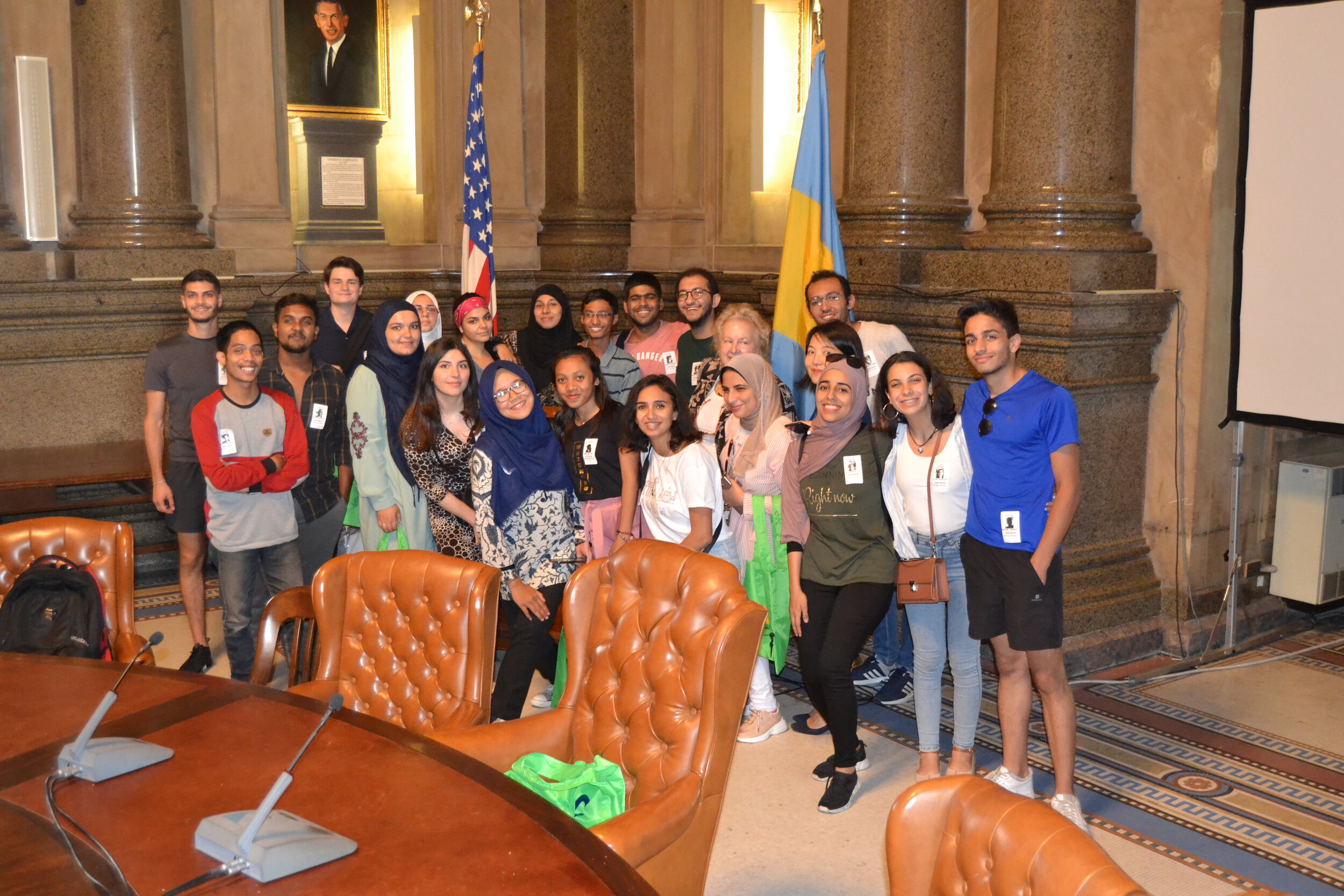
Despite all the work, the fourth of July 2019 was the only time in recent memory I felt I was fully celebrating the holiday without apprehension or a sense of hypocrisy. Independence Day celebrations often feel blindly jingoistic to me, a day when everyone ignores the countless social issues that the US grapples with to rally around some skin-deep concept of freedom. Especially since the election of President Trump, the U.S.’s issues with race, Xenophobia, Islamophobia, and anti-Semitism have been laid painfully bare. There are days when I feel genuine shame for being a citizen of a country that allows these things to happen. Reminders of the nation’s issues, of how many people would rather the USA be a white Christian man’s country only, are more frequent than the reminders of the ideal America that could be. On the fourth of July 2019 though, SUSI put a glimpse of the ideal America right in front of me. Visitors from other nations and cultures, enjoying an American tradition right in my own backyard. To imagine such a free and joyful cultural exchange as an everyday occurrence in my country stirs my soul. I don’t know if it’s a possibility within my lifetime, but the ideal America is one worth working towards.

My SUSI Experience

Driving into Center City Philadelphia for the first time is a memory I won’t soon forget. It was quite easily the largest, most complicated highway I’d ever driven on. I had a ton of luggage packed for the next few weeks I’d be interning with the Study of the United States Institutes program, and my usual cop-out of taking the train wasn’t an option. Just three years prior I’d had a similar experience starting college in Reading. Although the town lies a mere 30-or-so miles from my hometown, I hadn’t ventured much further than where I resided in ‘Small-Town-USA’.
Let me start by saying that Philadelphia is one of the most culturally rich cities I’ve had the pleasure of visiting. I found it amazing that I was just as captivated by the city as the SUSI Students and Scholars - and I had lived just 45 minutes away for the past twenty-one years! Over the course of the month and a half that I stayed on Temple’s campus, I realized that the city provided so much fertile ground for new experiences and dialogue.
The first day of my internship was the designated day to pick up our SUSI Students from the airport. Knowing I’d have to drive in more uncharted territory, (Side note: I’m sure this is completely casual, everyday driving for 99% of the population) I showed up comically early. Seriously - three hours early. I stopped at a shabby diner and drank cup after cup of coffee, wondering who I would soon meet and get to know. As we shuttled students back and forth from the airport, each arriving on flights from all over the world, every single one seemed endlessly optimistic about the adventure we were about to embark on.
The experiences I had with both the students and scholars are far too many to rattle on about - but I’d like to highlight a core element of all my experiences. As an intern, I was there to help provide an educational and memorable experience. Little did I know that the students and scholars would do the same for me. I engaged in dialogue with incredible minds - both young and senior - from places in the world I would have never imagined I’d have friends. Besides this, I got to experience dialogue in the city of Philadelphia and New York alongside these new friends. With each friendship came new perspectives, new wisdom, and new lessons.

The closing ceremonies for both the students and the scholars were bittersweet. I’ll forever cherish the moment in time that we were all together, living the SUSI experience in the city of brotherly love. To say that SUSI was a transformative experience is barely scratching the surface of the growth I experienced as a staff member during the program. The SUSI program brought together a group of the most brilliant, innovative minds I’ve had the chance to dialogue with. Many of the friends I made gave me beautiful parting gifts and heartfelt letters, all of which are proudly displayed on a shelf in my room to remind me of my surreal summer in Philadelphia.
We live in a world where bad news is a constant, still, I can’t help but be optimistic. Those brilliant minds that lived the SUSI experience have now returned home to be leaders in their respective countries, and I can’t wait to see the ways they change the world.

The Role of Religious Networks during the COVID-19 Crises
A reflection from Argentina [1]
By Maria Eugenia Funes
After more than four months of social isolation, job losses, and general social, economic, and political crisis, the COVID-19 pandemic has put humanity face-to-face with its non-sustainable way of living. The devastating economic and social consequences of this pandemic demonstrate that our increasingly unequal economic systems have been aggravating environmental destruction and wealth concentration all over the world for decades. Taking into account that religion is an important part of many people’s lives, it is timely to ask ourselves: how are religious and spiritual leaders and followers responding to the many layers the current crisis presents? What can we learn from them?
Religious leaders developed a first response to the different social isolation measures disposed by most of the countries in the world in order to keep up with the spiritual company given to the faithful. In a context where religious sites were closed and religious gatherings, pilgrimages, and celebrations banned, religious leaders and communities developed creative ways to stay in contact and transmit their messages. As with many other social activities, congregants used video-calls for religious rituals and meetings, and thus, the domestic space acquired a new density in the spiritual lives.

But the practices of religious leaders and communities have not been limited to the symbolic dimension but addressed the many material needs that emerged in this context. The different religious groups present in Argentina [2] show an interesting range of experiences regarding the responses of religious groups to social and economic crises. In addition to the traditional organization of food, clothes, and shelter donations to people in need, some religious spaces, like nunneries, were transformed into healthcare centers for people with symptoms of COVID-19. Furthermore, the social networks developed in religious spaces have proven useful for people that lost their jobs for selling products, like facial masks, and for risk populations, like old people, to receive help from other members of the community to cover their everyday needs. These sociability networks have also been fundamental for psychological and spiritual company and support. These practices were not only carried out by the Catholic majority, but also by all the minority religious groups in the country: Evangelicals, Buddhists, Jews, Muslims, Latter Day Saints, Umbandas, and Kimbandas, and even Holistic Centers.
Many of these initiatives are developed in articulation with other actors of the political and social service sectors. Some of these religious groups are coordinating their activities with the State and other civil society actors, like NGOs. Recognized figures of sports and show business, and many ecumenical and interreligious spaces, have been used to organize solidarity practices. In addition, many have developed their own versions of traditional political practices, such as the organization of collective meals, known locally as “ollas populares”, which spread along the country particularly after the economic and social crisis of 2001.
Finally, the religious field has, alongside other realms of social life, taken over the concerns towards the building of more sustainable ways of living that could ensure better social and environmental conditions for humanity. In that sense, during the COVID-19 crisis, Pope Francis’ circular Laudato Si has been actively revisited among many other religiously-informed discourses, promoting practices that involve taking care of the environment. Furthermore, spiritual cosmovisions are influencing economic models that aim to include social and environmental problems to the private sector agenda. This has been the case with the influence of anthroposophy in the development of a social bank project, the Latin-American Ethical Bank, strongly promoted by people involved with this esoteric discipline in Brazil, Chile, Argentina, Colombia, and Uruguay.
All of these practices developed in the religious arena remind us of the central role religious and spiritual groups and networks have during crises like the one we are going through. Even though the religious leaders and groups have seen their everyday ways of experiencing their faith transformed, this didn’t mean they vanished from the social space but, on the contrary, they developed creative ways to be in contact with the transcendent and they intensified their social interventions. As stated above, religious groups are providing both spiritual and material support, as well as symbolic resources, to reflect upon a future where religious values are put at the service of building a better world.
[1] This entry was written with the support of “La Confra” a network of South American women researchers on religion.
[2] For a quantitative description of this diversity see http://www.ceil-conicet.gov.ar/wp-content/uploads/2013/08/ii25-2encuestacreencias-en.pdf
1. Ollas Populares could be translated literally as “popular pots”. They consist of big collective meals, generally cooked in big pots, organized by political or social organizations in contexts of economic and social vulnerability.

My SUSI Journey
by Alfred Bornea Taboada
(Philippines) SUSI 2019
Religious Freedom and Pluralism
Dialogue Institute, Temple University
“Nobody knows everything about anything, therefore dialogue,” a powerful line shared by the Founder of the Dialogue Institute at Temple University, Prof. Leonard Swidler. He shared it in the morning of the first day session and it was like a last song syndrome (LSS) that keeps repeating in my mind until today. Hearing it from the author himself was a respite from a load of doubt and delight while on my way to the United States for SUSI 2019. Prior to coming, I had mixed feelings of who are the people I would be meeting, what the program would be. On the flip side, I was excited at the thought that I would be representing the Philippines to an international discourse. Such an opportunity for me to impart and share my country’s best to everyone and at the same time learn about peoples, places, passions, cultures, and spaces made me happy.
Religion for me is not an issue. I grew up in an ecumenical family. My father is a Roman Catholic, my Mom is a Protestant Presbyterian, and my other siblings are catholic and protestant as well. My relatives are Baptist, Methodist, Jehova’s Witness, Seventh Day Adventist and others, too, are Islam. I can go to churches, temples, and mosques without any reservations. There was no single instance that I was deprived of or told by my parents not to attend other church services. Now, I just realized that it was a form of religious freedom and pluralism my upbringing gave me.

My Ph.D. is in Peace and Development and one of the courses of this program is Religion and Peace. I taught the subject once in a trimester and the curriculum was far different from the context of religious freedom and pluralism. I have been an advocate of Interreligious Dialogue (IRD) considering I live in the Southern part of the Philippines, particularly in the Bangsamoro Autonomous Region in Muslim Mindanao (BARMM), where rich diverse cultures, traditions, and religions are highly evident. In fact, some areas of the region were war-torn for several decades now. Many people believe that conflict and wars in this place were attributed to religion but actually NOT, politics and economics were the culprit. It just happened that the conflicting parties are Christians and Muslims. This SUSI program indeed was an opportunity for me to nourish my knowledge, attitude, and skills in terms of dialogue amidst pluralism, including understanding more fully my own region.
The advent of SUSI’s series of lectures, exposures, visits to churches, synagogues, temples, mosques, Amish and Bahai communities, and even meeting up those at a prison facility widened my interest in pluralism. It inspired me to replicate the sessions and engagements outlined. Our eating sessions involved exchanging pleasantries with all those beautiful people we met, all of whom were amazing. Good food really follows good conversation and vice versa. Such a journey brought me several reflections of learning for life. I coined it D.I.A.L.O.G.U.E for easy recall.
Deep Dialogue
Intensify Inter-intra Religious/ Ideological Dialogue
Appreciate the value of one’s individuality and uniqueness
Learning is Changing (in reference to Decalogue number 1)
Observe an I-Statement / Message and Emotional Intelligence all the time
Guided by the attributes of Faith, Love, Integrity, Excellence, Respect, and Service (FLIERS)
Unity amidst Diversity
Engage in an environment of freedom and pluralism towards a Blessed Community
I really had robust learnings from the program. The theories and experiences I got have been translated into a concrete reality. The moment I got back at the Graduate School I made a courtesy call to our Dean (SUSI Alumna of a different program). She was delighted to hear about the program and the plans that I am going to implement. I was assigned as chair of the course for the Outcome Based Education Curriculum Enhancement and was able to develop a graduate level program outcome, particularly in Religion and Peace with the support of my collegial team and the Dean.
During the third trimester, I taught Interreligious Dialogue. I designed the syllabus according to the context of religious freedom and pluralism. One of the most memorable experiences and complimentary reviews I got from my graduate students was the Shia and Sunni Encounter. In my country, Shias are not so popular and such groups opt not be known in public for fear of condemnation. In the spirit of religious freedom and pluralism, I invited to my class a team of Shia to engage in dialogue with my Sunni students. There were exchanges of thoughts and several questions were raised. Some apprehensions, discriminations, and doubts were then cleared. It was very delightful to see at the end of the session that these two denominations were gathered together and caught each other’s drift.

It was only unfortunate that the Covid-19 curtailed our Interreligious Immersion and Church visitations. However, despite the lockdown, my students were able to write papers on any Inter Religious Dialogue, Religious Freedom and Pluralism related-issues and topics. The pandemic also has been an eye opener to everyone regardless of faith or religion to join together in supplication and share blessings to everyone in need. This is just the beginning and the gospel of dialogue will live on.
Finally, I would like to take this opportunity again to thank the American People for part of their taxes were spent in this highly relevant and truly rewarding cause. I want to thank as well the U.S. Department of State, the Dialogue Institute: Prof. Leonard Swidler, Prof. Rebecca Mays, Dr. David Krueger, and staff, The D.I. Board: Sergio Mazza, wife Lora, Atty. Kay Kyungsun Yu, Dr. Larry Fultz, and to all their partners.
To conclude, experiencing the truest essence of pluralism is having an opportunity of connecting with these wonderful classmates, that I call “Best Angels,” from the different sides of the world. They are my extended networks in dialogue and peace. Maria of Argentina, Amena of Austria, Malahat of Azerbaijan, Jian of China, Takalign of Ethiopia, Juha of Finland, Ilias of India, Isnur of Indonesia, Yasmeen of Jordan, Mirkhat of Kazakhstan, Fr. Martin of Kenya, Ghassan (Jason) of Lebanon, Lau of Malaysia, Wei of Myanmar, and Sakir of Turkey. From the Philippines, thank you very much for sharing your country, religion, beliefs, foods, and culture with me. I really had a wonderful time with you and you made my SUSI journey memorable. You are all tattooed in my heart and mind. All the best to you and your family. Till we meet again.
Godspeed.

Teilhard: The Phenomenon of Man

THE PHENOMENON OF MAN [1]
of Pierre Teilhard de Chardin
A Portion Briefly Presented and Commented on by
Leonard Swidler (dialogue@temple.edu) [2]
This book was written in the 1930s with Fascism (Italy), Falangism (Spain), Nazism (Germany), and Stalinism (Russia) raging, Teilhard offers an admonition not to be discouraged:
“Despite an almost explosive acceleration of noos-genesis [3] at our level, we cannot expect to see the earth transform itself under our eyes in the space of a generation. Let us keep calm and take heart.... Monstrous as it is, is not modern totalitarianism really the distortion of something magnificent, and thus quite near to the truth?”—Corruptio optimae, pessima. [4]
A. The Personal Universe
Teilhard indicates that the whole pattern discernible in evolutionary movement in the universe from the bottom up moves in the direction of consciousness, even of a supreme sort: “Evolution is an ascent towards consciousness.... Therefore, it should culminate forward in some sort of supreme consciousness.”
He then provides a brief analysis of the inner structure of consciousness which leads inevitably “upward”: Every consciousness is possessed by a three-fold property: “(1) of centering every-thing partially upon itself; (2) of being able to center itself upon itself constantly and increas-ingly; and (3) of being brought by this very super-centration into association with all the other centers surrounding it.”
Teilhard finds that the universe in the forms of space and time structurally move in a “curved,” “converging” fashion eventually leading to consciousness and beyond its primitive forms to an ultimately universalized Consciousness—Omega Point: “Because it contains and engenders consciousness, space-time is necessarily of a convergent nature. Accordingly, its enormous layers, followed in the right direction, must somewhere ahead become involuted to a point which we might call Omega, which fuses and consumes them integrally in itself. However immense the sphere of the world may be, it only exists and is finally perceptible in the directions in which its radii meet—even if this were beyond time and space altogether.”
This language and imagery reminds one of the image of Ultimate Reality being like the Horizon, always receding (which image was also used by two other Jesuits of an only slightly younger age: Karl Rahner and Bernard Lonergan), “luring” us forward (to use a Whiteheadian process-thought term for Ultimate Reality, “God”). As a humanist Marxist might say: Being human is a never-ending task.
Quite different from the advaita version of Hinduism, or of Buddhism, Teilhard insists on the person not being totally absorbed, obliterated or “blown out,” as in Nirvana: “It is therefore a mistake to look for the extension of our being or of the noosphere in the Impersonal. The Future-Universal could not be anything else but the Hyper-Personal–at the Omega Point.”
B. The Personalizing Universe
Teilhard stresses his vision that persons are the acme of the universe and that they can never disappear—this is the thrust of the evolution of the universe:
The universe is a collector and custodian of consciousness, the mere hoarding of these remains would be nothing but a colossal wastage. What passes from each of us into the mass of humanity by means of invention...is admittedly of vital importance.... But, far from transmitting the most precious, we are bequeathing, at the utmost, only the shadow of ourselves. Our works? But even in the interest of life in general, what is the worth of human works if not to establish, in and by means of each one of us, an absolutely original center in which the universe reflects itself in a unique and inimitable way? And those centers are our very selves and personalities. The very center of our consciousness, deeper than all its radii; that is the essence which Omega,[5] if it is to be truly Omega, must reclaim.... To communicate itself, my ego must subsist through abandoning itself, or the gift will fade away.”
The higher the development of consciousness, the more it must exist and persist in its own reality without absorption. This is the unavoidable pattern of the universe:
The conclusion is inevitable that the concentration of a conscious universe would be unthinkable if it did not reassemble in itself all consciousnesses as well as all the conscious; each particular consciousness remaining conscious of itself at the end of the operation, and even (this must absolutely be understood) each particular consciousness becoming still more itself and thus more clearly distinct from others the closer it gets to them in Omega.
Here is a clear insight (i.e., center-to-center union intensifies the distinct being of each center in proportion as they unite) which connects the whole universe and points ineluctably to the perfection and continuance of all parts—in this case, individual conscious persons:
In any domain—whether it be the cells of a body, the members of a society or the elements of a spiritual synthesis—union differentiates. In every organized whole, the parts perfect themselves and fulfil themselves. Through neglect of the universal rule many a system of pantheism has led us astray to the cult of a great All in which individuals were supposed to be merged like a drop in the ocean or like a dissolving grain of salt. Applied to the case of the summation of consciousnesses, the law of union rids us of this perilous and recurrent illusion. No, following the confluent orbits of their centers, the grains of consciousness do not tend to lose their outlines and blend, but, on the contrary, to accentuate the depth and incommunicability of their egos. The more ‘other’ they become in conjunction, the more they find themselves as ‘self.’ How could it be otherwise since they are steeped in Omega? Could a center dissolve? Or rather, would not its particular way of dissolving be to super centralize itself?”
Teilhard then presents a vision of the ultimate goal of the universe, i.e., the gathering together of all being into the consciousnesses of persons who will be drawn to this culmination by distinct Consciousness at the center, as the dynamo from which all energy/being radiates—he says it better:
By its structure Omega, in its ultimate principle, can only be… a grouping in which personalization of the All and the personalizations of the elements reach their maximum, simultaneously and without merging, under the influence of a supremely autonomous focus of union.... called henceforward Omega Point”
Teilhard says that each individual’s natural tendency is to move more and more toward self-preservation and expansion by way isolation or domination—but that is a self-defeating strategy:
Egoism, whether personal or racial, is quite rightly excited by the idea of the element ascending through faithfulness to life, to the extremes of the incommuni-cable and the exclusive that it holds within it. It feels right.
But then he points out that it is not separateness as such that is important, but the person. However, one becomes person only by way of mutuality, center to center union—this is the law of the evolving universe:
Its only mistake, but a fatal one, is to confuse individuality with personality. In trying to separate itself as much as possible from others, the element individualizes itself; but in so doing it becomes retrograde and seeks to drag the world backwards towards plurality and into matter.... To be fully ourselves it is in the opposite direction...that we must advance —toward the “other.” The goal of ourselves, the acme of our originality, is not our individuality but our person; and according to the evolutionary structure of the world, we can only find our person by uniting together.... The true ego grows in inverse proportion to “egoism.” Like the Omega which attracts it, the element only becomes personal when it universalizes itself.... Since it is a question of achieving a synthesis of centers, it is center to center that they must make contact and not otherwise.
“Which brings us to the problem of love….”
[1] The Phenomenon of Man (1959 ed.) Book Four, Chapter Two, (Beyond the Collective: The Hyper-Personal)
[2] I found this on the hard drive of my laptop as distilled for a graduate seminar in 1996 from my reading Teilhard’s Magnum Opus, The Phenomenon of Man, 1958 edition,.
[3] Nous (Greek, “thought.”
[4] Latin, “Corruption of the best is the worst.”
[5] Omega is the last letter in the Greek alphabet; therefore, a symbol of the Ultimate.

A “Second Fall” or a “Forthcoming Resurrection”?
Religious Narratives of a COVID-19 Infected World
Yosra Elgendi
American University in Cairo
COVID- 19 is one of those crises that our generation and the younger generations are not accustomed to. Hence, it is possibly one of the reasons that we are ill equipped with the spiritual “skills” and “capacities” to handle such a crisis. The language we use and the way we think about it as an obstacle to economic progress, rather than a natural element of life that can reveal something profound about human vulnerability and precarity, is perhaps part of the technological era that we live in in which instrumental rationality has taken root. This instrumental rationality has entered the religious domain and shaped the religious narratives that try to make sense of the crisis. Newspapers reflect this dynamic.

Much of the newspaper reporting about the current crisis has focused on the closures that affected the houses of worship. The reporting focused on how different religions have either accepted or resisted the closures and how they made sense of them to their adherents as well as how they circumvented the closure conditions to continue praying through video-conferencing. This may remind us that religions are not extra-political after all, lest the Westphalian narrative made us forget. Indeed they are deeply embedded in a religious-political or temporal- spiritual structure and balance of power that they are expected to conform to. Hence, while the religious narratives of the crisis have a hugely consoling role to play, they also reflect within them social and political structures. I will give only a few examples of newspapers/ websites that have reflected on the religious narratives of the current crisis in the contexts of Egypt and the United States.
Some Egyptian commentators and journalists have focused on highlighting the COVID-19 crisis as a “punishment” for the wrath of God. Both pro-government websites as well as Muslim Brotherhood (oppositional) websites hosted such views. Both ascertained that there is a divine wrath but for different reasons. The Yaum- Al- Sabi’, a private newspaper with close connections to the regime, argued in an article that the narrative of divine punishment results from the lack of people’s obedience.
“God warned people against the consequences of disobedience and defiance, which include epidemics (Leviticus 26:21,25). So we remind of two times God of them took the lives of 14,700 people, and in the other 24,000 people because of disobedience in various forms (No. 16: 49 and also 9:25).
After God gave the law to Moses, he commanded the people to obey them so that they would not suffer many evils: "The LORD will strike you with wasting disease, with fever and inflammation, with scorching heat and drought, with blight and mildew, which will plague you until you perish.”
Furthermore, oppositional media websites that stand against the Egyptian regime politically also joined the chorus in agreement that the pandemic is a punishment, albeit for a different reason. The reason to them is the political repression taking place in Egypt (and Syria).
“I used to tell my friends that the file may have been closed on Earth, but it was not folded in the sky, and that those who covered up the crimes of genocide in Egypt, murder and cremation on the day of the Holocaust, and covered up the killing of the Syrians, will strike upon them a thunderbolt from the sky that hurts those who did wrong in particular! My opinion was that in the face of these crimes and covering them up, the sky would intervene …”
While the Egyptian narratives focused on the narrative of the “punishment” for the “befallen” political actions, some American outlets focused on the “upcoming resurrection narrative.” For example, a Foreign Policy report highlights how epidemics were instrumental to the successful spread of Christianity.
“But the more famous epidemic is the Plague of Cyprian, named for a bishop who gave a colorful account of this disease in his sermons. Probably a disease related to Ebola, the Plague of Cyprian helped set off the Crisis of the Third Century in the Roman world. But it did something else, too: It triggered the explosive growth of Christianity. Cyprian’s sermons told Christians not to grieve for plague victims (who live in heaven), but to redouble efforts to care for the living. His fellow bishop Dionysius described how Christians, “Heedless of danger ... took charge of the sick, attending to their every need.”
The narrative of the ‘positive outcome’ of the epidemic was also reiterated by the Washington Post’s reporting that the closure of the churches - as a result of the epidemic - is actually contributing to a deeper faith experience than when the churches were open with an implicit critique of institutional religion.
One in four Americans say the coronavirus has deepened their religious faith, a poll released Thursday found, including a majority of black Protestants. Just 2 percent said the virus has left their faith weakened.

Of course, these newspaper narratives are not generalizable. Needless to say, a more systematic research regarding the religious narratives of the pandemic needs to be undertaken. How can these very different views of the same phenomena be understood? These stories cannot be tied to the extent of pandemic’s impact on countries as the United States has been hit hard with some 2,888,000 cases in the US (July 2020) versus only 70,000 in Egypt up to the writing of these lines. Hence, how can these different narratives be explained?
The relations of religion with the structures of power are one way of understanding the differences of these narratives. In the Egyptian case, religion is clearly built in the vertical structures of power through which politicizing religion (ie. using religion for political ends) is only a manifestation. However, in the American case, religious bonds are horizontal bonds that can dare to discuss religion outside (and sometime even different from religious institutions). As a reaction to the political, religion is constructed as being led by the political- in the form of obedience or repression - hence led by the material and worldly. However, as a civic religion, religion is constructed as a meaning-making force for individuals and communities who are constituted by religious narratives - in part - through being consoled in times when all need a religious consolation.

The Importance of Interpreting Worldviews
4/15/2020
By Sayge Martin
The first time I read The Spirit Catches You and You Fall Down by Anne Fadiman was the first time I felt utterly challenged by another worldview. The story revolves around Lia Lee, a Hmong child suffering from epilepsy and struggling to obtain proper care from a healthcare system lacking skill in cross-cultural communication.
Originally from Laos, the Lees moved to Merced, California in the 1980s. Their daughter, Lia, was diagnosed with a severe form of epilepsy named Lennox-Gastaut Syndrome. They faced many hurdles while attempting to get treatment for Lia, mainly the lack of proper translators coupled with the fact that their Hmong beliefs clashed with the method of treatment used for epilepsy in the United States. Fadiman maintains a distinct dichotomy between Hmong spirituality and the Western doctor’s science to emphasize the refusal of both parties to step outside their deeply entrenched belief systems. Because doctors couldn’t effectively communicate with the Lees and didn’t attempt to empathize with their traditional Hmong beliefs, there were miscommunications about medical dosages as well as refusal from the parents to give certain medications due to mistrust. Lia's condition worsened. At four years old, Lia suffered a seizure that left her in a persistent vegetative state for 26 years.
Ultimately, the book encourages widescale education initiatives for healthcare workers as well as additional support from outside resources to raise awareness about nuances in treatment based on cultural differences. Through cooperation and compassion, a standard of care can be upheld that prioritizes respect for both patient and practitioner.
In light of the global pandemic, I find myself thinking of the book often. How many people are experiencing religious and cultural barriers in the healthcare system today? And how many healthcare workers are trying to bridge these gaps, but lack assistance in the form of translators and cultural mediators?
When proper support is in place, dialogue can occur that highlights the scientific recommendations of a doctor while taking into consideration the personal beliefs of a patient. Individualized care can be administered in a way that minimizes miscommunication and offers alternatives when applicable. Dialogue is a central aspect of daily life and proves to be a skill necessary for everyone. Dialogue skills in healthcare, specifically, are essential to prescribing a successful method of treatment.
As with any blog post, article or written piece, I encourage readers to reflect on the topics presented. The book referenced is 'The Spirit Catches You and You Fall Down: A Hmong Child, Her American Doctors, and the Collision of Two Cultures' by Anne Fadiman, 1997 - A great read if you’re looking to learn more about the story in the post.

Searching - Finding/Not-Finding - Still Searching
1/30/2020
By Leonard Swidler

Updated 1/26/21
I don't know: If there is “Something” out there that is so super-wonderful, but reveals Her/His/It/self only to a rather select few, “It” doesn't seem to be even as loving as I am – and have many shortcomings therein.
Maybe, however, there is a sort of Alpha/Omega that is evolving in Existence ever “greater” (not in the quantitative sense, but qualitative), an infinitely ahead of me/us Source/Goal of all Energy, Power, Consciousness, not static but dynamic – Be-ing, ing, ing…...?
After all, we know that our Cosmos started out 13. Billion years ago tinier than an atom (!), exploded (Big Bang!) and is still expanding-ing,ing,ing…. at the speed of light (186,000/miles per second!!!).
However, while we are here – now! – why don’t we each – individually and together – work as intensely as possible to make ourselves personally and communally, as loving as possible.
For my part, rather than looking “over there,” I prefer to put out my hand and heart to the ones I can reach, touch, somehow, here and now.
In my youth, in the monastery, and afterward, I strove mightily to attain some inner taste of that Alpha/Omega. Now at age ninety-two, I am no longer excited by the prospect of grasping/being-grasped-by “Being/Goodness/Truth/Beauty.” Rather, I am content with, each moment, being the recipient of all the being, truth, beauty, goodness in the now increasingly touchable global being. I embrace the persons I meet and engage, both those in front of me, and those also truly present to me via the internet, and whatever else is being developed in the coming cascade of ever more rapidly newly developed means to embrace each other in love: in Philia, Agape, and Eros – each in her/his individually profound ways.
*******
I don’t know. But I do feel there is Being out there, and here – super wonderful, who reveals Her/Himself to all beings capable of loving. She/He seems to be much more loving than I am since Love is what He/She is said to be. She/He is called the Source of all Being, who says, “I am who I am,” or, newly understood, “I will be who I will be.” Thus, when I embrace the persons I meet, and engage those in front of me, I somehow touch and feel Alpha/Omega that is all-loving. I somehow enter into Being, into Agape, Philia, Eros, Love. I can sing, dance (now, only haltingly), shout, praise, give thanks with the whole universe…
Agape,
Friend!
Leonard Swidler, dialogue@temple.edu

The Meaning Of Love—a Reflection
1/10/2020
By Leonard Swidler
Updated 1/30/2021

The Meaning of Love: A Reflection
Leonard Swidler (dialogue@temple.edu)
O Theophila*, you ask about the meaning of love.
Limitless words have been spoken and written to try to grasp the meaning of that word, and the reality it tries to name.
You ask, “What do I think it means?” Let me take your question seriously and try to lay out my understanding as clearly as I can. This will be longish, and in the beginning, mostly “dry,” but “feeling” will creep in gradually.
First, at the most fundamental level: “What do we mean when we use the word ‘good’”?
—That was “good” ice cream.
—That was a “good” performance of Mozart;
—George is a “good” friend….
We all understand when someone makes those statements. But what does “love” mean in those very different statements?
I understand it to mean: “I wish to become one with” Mozart, ice cream, George….
Whenever we perceive the “good” we want to become one, united, with it.
That then raises the question: What do we mean by the word “good”?
I think we have in our minds: An idea of what something should do, and when it does that, we say that it is “good.”
Thus, we think that ice cream should be, for example, sweet, cool, soft…., and to the extent the ice cream we are eating does those things, we think/say that it is “good,” or “not good,” or “very good”….
Of course, different people might have different understandings of what ice cream should be like: It should be very soft, or, medium soft, or, almost hard, or, very sweet, or, slightly sweet…. To the extent that this ice cream does what I/you think ice cream should do, I/you say that it is “good,” “very good,” “not so good,” “bad.”….
The same is true of music: We think that this sound should “calm our feelings,” or “arouse our feelings,” or “be pleasing to hear,” or….. To the extent it does those, and/or things, we say that it is “good,” “not so good,” “bad.”…. Because different persons might have similar, or very different, ideas about what music should do, we have differing judgments as to whether Mozart’s music is “good” or “not.”….
When I say that George is a “good” friend, we understand that a friend is a person who “we can depend on,” “will sympathize with us when we are sad.”…. If George does that a lot, we say he is a “very good friend.”….or not such a good friend….
Again, when we use the word “good” we mean that this “thing”—ice cream, Mozart, George…is doing what we understand ice cream, Mozart, friend should do.
Here is where “love” comes in:
Love fundamentally means, “We want to become ‘one’ with what we perceive as ‘good.’”
Thus, I want to become one with ice cream by eating it. I don’t want to “eat” Mozart, but I want to “become one” with him by “listening” to his music. I want to “become one” with George, not by “eating him,” or by sitting quietly with my eyes closed and listening to him endlessly; I want to “be one” with him by talking together with him, sharing his joys and sorrows, helping him when he is in need….
So, to my Beloved: I perceive you as a “good” friend, and thus, I want to talk with you, share my joys and sorrows with you…. I want to become “one” with you in endless ways…
Because you and I are “persons,” my love for you means that I want to be “one” with you in the endless ways that only persons can be one with each other. All those different ways are endless because Persons are made “In the Image of God” (Gen 1:27), who is endless.
Even if a person doesn’t believe that “God” exists (historically, we humans have had such wildly contradictory understandings of “god” that it is understandable that many find the idea of “God” unacceptably confused), there is in us humans an “endless” quality. We reach out endlessly in every direction—wider, wider, deeper, deeper…. without end.
Even when the body ceases to exist; even when there doesn’t appear to be a separate “soul” in us humans (Where was my beloved Andie’s “soul” when she slowly disintegrated from Alzheimers before my eyes for seventeen years!? I don’t know; Ich Weiss es nicht; Je ne se pas; Io non so…). Still: There is this endless, “infinite” quality that exists in each human person. What it might be after the death of the body, we don’t know.
Nevertheless, we have this endless yearning. For us humans, reality is endless, not only in “time,” but also in “space,” that is, we endlessly reach out to Become one with—Love—all “Being,” which we come to know endlessly, and hence, move to become “one with….”
Thus, my “loving” you means that I am yearning to, moving toward, becoming one with you more and more…. endlessly. At the same time, my perception of you, my loving you, my becoming one with you continually expands/deepens so that mysteriously you grow ever greater. Somehow this loving you, this moving to become one with you, draws more and more of reality to be one with you—and me. Thus, endlessly all becomes One, Good….You—and I move to become with You, and you are endlessly expanding.
Is this what we mean—or, perhaps, better, somehow “experience,” yearn for—when we read and make our own in the New Testament “Letter of John” (1. Jn 4:8): ho theos agape estin, “God is love.” Or, maybe, yet deeper in the inverse: he agape theos estin: “Love is God!”
Love, Len 1/30/2021
*****
* Acts of the Apostles, 1:1. Ho Theolophile (Greek, Ho, “Oh”; phile, “love”; theos, “God”).

Stuck in the Middle with You: A Dual Perspective
7/26/2019
by Stephanie Abboud and Mahmoud Eldronky

A short preface; the following are two articles meant to be read in tandem as one. Two former SUSI students wanted to share the story of their experience from each of their perspectives. Specifically Stephanie and Mahmoud wanted to write about their interactions with each other over this time and what they came to understand of one another.
Stephanie Abboud
On the eve of our departure back home, all of us gathered into a circle and were asked to share what we’re really taking back home with us from the program. When my turn came, with tears in my eyes, I talked about how Mahmoud and I each came from one of the two opposite ends of a spectrum, but somehow managed to meet in the middle by the end of the program. Everyone in the room knew about the clashes that happened (a lot and very often) between Mahmoud and I. So when I spoke, they all laughed. I didn’t have to try too hard to explain, almost everyone witnessed our stand-offs, and they all witnessed our eventual friendship. I think most of them were intrigued by the special bond we shared. As I look back at it now, I’m certain it must have been a beautiful process to watch.
Mahmoud is a year older than me, and while that doesn’t make for a difference between us, there were many other things that did. We came from different genders, different countries, different religions, and different societies. A difference in one of these characteristics would not do much –but the combination of differences in all these characteristics set us straight out on a collision path. Don’t get me wrong, Mahmoud is amazing with a heart of gold, but getting to know him was tough.
During our first days in the US, I had the impression Mahmoud was a cool and fun guy (and he is). A few days later, we had our first disagreement, and apparently, it wasn’t going to be cool between us. Mahmoud told me he did not believe in friendships between men and women. I, not only did, but most of my friendships were with men. That meant my friendships were something he frowned upon, and I did not want him to judge me. So after failing at convincing him (and at making myself look moral), I promised to show him that not only are inter-gender friendships possible, but beautiful too. Little did I know back then that this was not going to be the last of it.
Two days later, I found the audacity to ask something that surprised him “Am I an infidel to you?” This was our first dialogue about religion –the first of more to come. I did not want him to sugarcoat it to be polite, so I kept arguing and pushing him to admit that he did, but he would not say it.
The following day, Mahmoud compared my outfit (a tank top and shorts) with our friend’s (long-sleeves and jeans). He told me with so much sass “She is cold. She is cold and you’re not.” I knew then that my outfits were going to become another thing Mahmoud frowned upon. From that day on, I would wake up every day and think “Is Mahmoud going to judge me if I wear this?” I wanted him to see me for who I actually am, not for what I wore. The day after, we were going to a mosque. I asked Zeynab, one of our friends, to put the hijab on for me the way she does it herself. Mahmoud scans me, smirks, and says “Did Zeynab put the hijab on for you? Well that’s not the proper way to wear the hijab. If you want to wear it like that, might as well not wear it all” and turned around. I stood disappointed –Here I was excited to be introduced to their religion and making an effort to dress appropriately, and he was criticizing me for wearing the hijab the same way a Muslim woman wears it herself. Later that morning, he commented on my ankles still being visible and on how that made my pants not suitable for the visit and walked away. I began wondering if our cultural and religious differences make him hate me.
The day before going to church, I made sure to get back at him and tell him to wear decent shoes out of respect to the place we’re going to. I thought he took me seriously. But the next day, he went in flip-flops. He was also talking and joking all service long. I was annoyed. Why could I show appreciation for his religion and he couldn’t respect mine?
A few days later, Mahmoud sat on the bench cross-legged in a basilica! I had enough of him. He wanted me to abide by his religion’s rules, when he couldn’t show basic courtesy towards mine.
Of course however, just like every story, ours could not have happened without a turn of events. Mahmoud and I were seated next to each other in a Jewish synagogue and talked together, but I was judging him inside, having had enough of him and his strict conservatism for the past two weeks. On our way out, Mahmoud suffered from a hypotension crisis. I was so scared for him and of losing him. The tears we all cried broke down the wall I had built against him. It was then that I realized that, no matter how much Mahmoud criticized my behavior, I had profound love for him. I think he realized that too then but he couldn’t understand why. And maybe that was the lesson we both needed to learn: Love for difference. We both can pinpoint that this incident broke the ice between us, but we’ll both still admit, to this day, that this wasn’t the end of it. And while it wasn’t the end, it was definitely the beginning of a friendship (he still won’t admit it’s a friendship, so he can call it what he likes). We began talking often, having friendly conversations and small talk, and enjoying each other’s company. Dialogue. But most of all, it was religion we discussed. Does God exist? Which religion has the real truth? Are Christians going to hell? The Holy Trinity, Jesus, Mohammad, the Qoran. Everything. But of course, we would face trouble again.
One night, when my advice on relationships to one of his friends back home included “A girl is free to do whatever she wants”, Mahmoud explained “She’s a Lebanese girl, so don’t really listen to what she says.” I stormed out of the room and didn’t even bother hearing his explanation. Am I too liberal for him and his friends to the point where my opinion should be disregarded? I was genuinely tired of our antics, and was giving up on getting anywhere with him.
On our way back from an Islamic Center, Mahmoud scolds us for not asking the Imam questions. He said that he was asking questions he already knew the answers to out of respect only. I looked at him and snapped: “Don’t talk about respect when you walk into church, sit cross-legged and flaunt your flip-flops when I had specifically asked you to wear sneakers for “respect””. He was surprised of my reaction and didn’t expect it. As he was answering, I, once again, walked away. That same afternoon, I wore loose pants and a bra-top for a pool party, as I thought I was dressed accordingly. Mahmoud yelled at me for hanging around the pool when the men were swimming. He could have explained that they believe it’s haram for me to look at their nude torsos, but he yelled instead. I was starting to get used to that, but what came next was, to me, the straw that broke the camel’s back. When I was casually talking to him, he handed me the nearest jacket he found, and told me “The next time you want to talk to me, dress accordingly.”
All trip-long, I had never been as outraged of Mahmoud, as I was when I heard those words, that I just walked away and sat on my own in the nearest room. I was furious. This was him blatantly imposing his culture on me. He had reached a whole new level: He wanted to change the person I am, my behavior, and the way I dress. He was saying that if I wanted to talk to him, I had to behave the way he sees fit. I was fuming. Some of our friends tried to mediate, tried to calm me down, and talked to him. But I wasn’t going to let it slide and Mahmoud wasn’t going to take it back. As fed up as I was, I decided to give him the silent treatment. The only times I would break my silence were to snap back at anything he would say with a clever comeback. I wasn’t going to let him hear the end of it. It was cute; we both wanted to be in the other’s presence, but ignored each other instead because of course we had a stance to hold.
The next morning, Mahmoud did not wear flip-flops to church. He wore sneakers. During the service, while he laughed a little, he would stand when everyone would, and sit down when everyone did. I loved watching him blend in. But I was still infuriated, so I wasn’t going to say anything or give him credit for any effort. Our friends kept trying to mediate for the next three days. Every time, I would list the things Mahmoud told me so far and explain how this was the worst of it and how fed up I am. But deep-down, it was him I wanted to be the one talking to. I wasn’t going to make the first-move so I kept snapping at him until he would react and try talking to me. And he did.
For the first time in 3 weeks, Mahmoud and I sat down together to talk. Two of our friends acted as facilitators as Mahmoud and I took turns to speak. I explained how angry I was, and gave evidence that I had reason to be. It was the first time I actually told him how I felt instead of ignoring him or walking away. Mahmoud really listened. He gave me the space to empty everything I wanted to say. He then explained to me his point of view and even apologized. I was happy to hear one but I just wanted him to understand how I felt. And for once, he did.
While Mahmoud and I had always discussed our religions and societies, this was the first time we sat down together and actually opened up about how our differences were affecting us. And by far, this was our most fruitful conversation of all. Moving forward, he still wouldn't admit any of us girls were his friends, or that I'm an infidel, but I stopped pushing him to. He stopped criticizing my outfits, and, together, we began having civil debates about our cultures and lifestyles. None of us had changed, but we had finally learned to accept each other the way each of us was.
Mahmoud and I spent the next two weeks on great terms. We enjoyed having each other around. He hung out with us more often, went out with us, talked more, and made some inside jokes. We took pictures together. I remember our friends’ looks of pride when they saw us talking, or insisting on waiting for the other to tag along. Proud of the place we reached. Before we went back home, he told me he was going to miss having someone praise him all day long. That night, he even addressed a group conversation to me. We were talking about salvation, and I still remember him looking at me with every word he said. Mahmoud also encouraged me to speak up when I was right and make myself heard. I did so when he pushed me to. We got each other goodbye gifts; I got him a book about Christianity he was looking for along with another book: “Seeking Allah, Finding Jesus”. I thought it embodied our experience together perfectly.
The last day, goodbye came. When it was time for me to leave, I had to find a way to properly bid Mahmoud farewell. He was busy with his back turned to me, so I ran from behind and hugged him with all the strength I had. With all the affection I’ve ever had for him –all the affection I could never show him because he absolutely is against all kinds of inter-gender physical contact. And that was exactly why he was taken by surprise and screamed “NOOOOO” right in the middle of the hotel lobby. You see, even when we had managed to put our differences aside and meet in the middle, we still clashed. Rebecca laughed; it was one last Mahmoud-Stephanie episode to end the journey.
Mahmoud and I learned the hard way that no matter how different two people are, there is always somewhere to meet in. The less different two people are, the easier a middle is to find. In our case, meeting each other halfway meant that each of us had to cross over a long, very long, path. But we did. We argued, fought, clashed, and even hurt each other. But we also talked, listened, made an effort, and found a middle ground. Dialogue really does bring people together, and bridge between cultures. I was a 21-year old Lebanese Christian girl, too liberal for him. He was a 22-year old Egyptian Muslim guy, too conservative for me. But we were both young, Arabs, and we both believed in God and shared some common morals and values. It took us a long while to learn to put our differences aside and focus on what’s beyond. Today, a year in, I couldn’t be any happier that we did. Mahmoud taught me (and he still does) so much. I still turn to him for questions about Islam. But beyond that, he made me more understanding than I thought I was, more tolerant, more accepting. The Stephanie that travelled to the US for SUSI in July 2018 was not the same Stephanie that came back to Lebanon in August 2018 –and I owe a huge part of that to Mahmoud and the journey we experienced together.

Mahmoud Eldronky
Before rewriting this article, I immersed myself in the folder of SUSI in which I keep all the dearest memories to me. Rereading what my friends wrote and Seeing the photos we took and videos we made was like getting back physically one year ago. Before this tremendous experience, very often did I find myself inclined to those who were like me. This journey was a major transformation for me in so many levels. At first I found myself more comfortable with the Egyptian group, until they blended with other groups. I ended up being in company with Omaima and Zeynab, and both are Muslims by the way. I told you so. From then, they were the closest to me all along this wonderful road trip. The major clash of civilization was with STEPHANIE…
I am a Muslim from Egypt and Stephanie is a Lebanese who comes from a catholic background; thus, both of us were meant to differ. I come from a society that is absolutely the opposite of Stephanie`s. In Lebanon –I guess- the society is more diverse than Egypt. You cannot tell the difference in many cases between Muslim and Christian girls. The culture is almost the same, which is why you can see many denominations are -somehow- getting close to each other. This convergence is in matters that relate to culture not religion! Another reason is the western identity that Lebanon had fully and successfully adopted. Lebanon has borrowed nearly everything from the lifestyle of Europeans –not bad but not good either-. The society is more liberal and, in some way, decadent. On the other hand, Stephanie saw in my society one that is controlled by extremely conservative, righteously indignant, women oppressors, self-centered, etc. The situation in Egypt is different. Egypt is a majority Sunni Muslim country, while the Coptic Christians is a minority. The ethics and values are almost the same for both mainstreams. Egyptian Muslims cling very much to their Islamic heritage, as we - Egyptians – are religious by nature. Islam is deeply rooted in the mindsets of Egyptians, and with religious institutions like Al-Azhar, this love and appreciation grows even bigger. Components like religion and heritage shape the Egyptian society.
During the program, we discussed many issues and topics. Among them all, Stephanie chose to argue with me specifically about friendship between a man and a woman. This was in Pendle Hill, Pennsylvania. Given my religious background, I believed –and still believe -that it is impossible to be friends with the other gender due to multiple reasons. I provided scientific researches and religious scriptures as well, but She was puzzled and asked herself '' how a man living in the 20th century could think like that? How dare you look at women like that? What is the status of women in your religion?'' She was agitated and since then she took it as her sole mission to convince me that it is OK to be friends with each other. Later on, she asked me to define the relationship between me and her. I said that we are colleagues, and apparently she was not satisfied with this answer. She wanted me to admit that we are friends- NO WAY-. In one occasion when we were visiting a Masjid and the girls were asked to put on a Hijab, Stephanie asked Zeynab to help her wearing it. For the record, I did not think Zeynab`s Hijab is the right way to put on a Hijab, so on seeing Stephanie`s Hijab, I was angry and said stuff I was not proud of. This was me imposing my religion on someone who is really trying to be open and tolerant with my religion and I was wrong. I really wanted her to experience the ritual as I saw it and I was very excited that they will have this experience, but things don't always go as they're planned.
When she realized at some point that –for her- I am a conservative, she just asked me if I believed that she is not decent, I was shocked for I was not acquainted with such blunt in my previous little experience with the other gender. I really do not remember my answer, but I can see her waiting for my answer and me stuttering looking for a right answer. Although my answer was diplomatic (as far as I can remember), but she did not like it and figured that I am trying to escape from such question. She believed that I now think of her the way she expected and unfortunately I did then. In the rest of the program, we were extremely opposite to each other in regard to ideas, beliefs and ideologies. We basically agreed that we are human beings, and disagreed with each other regarding everything else. We talked about God, whether he exists or not, also we talked about the prophet Muhammad and Jesus, judgment day, status of women, etc. In the early conversations we had, she used to yell at me. We both admitted that they were not civil conversations. We had similarities, but the scope of differences was much larger. It is hard for me to pinpoint the exact moment in which we decided that (Ok, let's agree not to disagree). One time I was talking to my friend in Egypt and he was seeking my advice concerning his future fiancée, I asked Stephanie if she has something to say and her answer did not match with my culture. I told him to ignore her cause she is a Lebanese (liberal, decadent and bad stuff), this word meant a lot and it came out spontaneously. She got mad agaaain and I was wrong as usual.
Another main event was when I had a seizure and was carried to the hospital. Actually, I cannot express how worried my friends were to the point that some of them cried. I still remember me lying on the ground, Othman lifting my legs, and Zeynab pushing against my chest in order to kill me or help me breathe (cannot tell). I did not see Stephanie, probably because she was weeping in the backstage. This incident showed me the amount of appreciation they hold for me. After that you can say she got soft on me, because I am sick and she was afraid that I would probably have another seizure during one of our conversations.
Stephanie was everything I hoped I am not in the beginning. She is so liberal; our culture is not the same, etc. At the end I hoped that this program would never end and that she will continue to teach me though. Her qualities especially her acceptance and tolerance with me were magnificent. I admit I had wronged her many times. I did not realize how cruel am I until she told me after we finished the program. One time I yelled at her because she was about to enter the swimming pool, while we -guys- are in it. She was upset but she can`t help but forgive me. I was a hard man to deal with, I know. I learned from her in these journey qualities like forgiveness, tolerance, caring, and many more. Through the journey, she never stops worrying about me or asking me to just go out with her -cool- group for once. Her sense of motherhood was her keynote character, Long story short, that is how two ends of spectrum had met.