
DI Leads Dialogue Training for International Exchange Program Alumni/ae
Dialogue Institute Director of Education Rebecca Mays facilitated a dialogue training in July for about 30 U.S. government-sponsored exchange program alumni, part of the U.S. State Department's Alumni Thematic International Exchange Seminars.
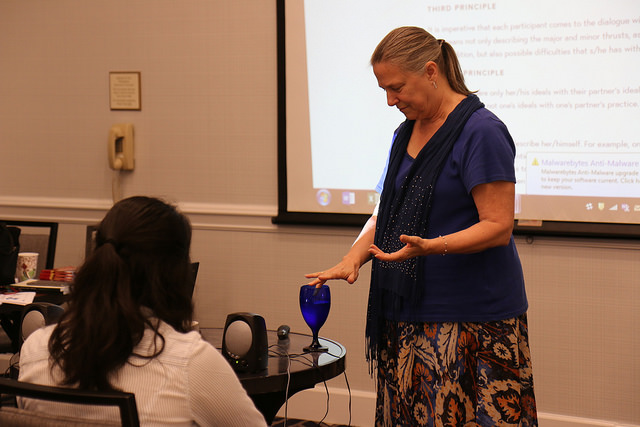
Director of Education Rebecca Mays
during the Alumni TIES workshop in July.
Dialogue Institute Director of Education Rebecca Mays facilitated a dialogue training in July for about 30 U.S. government-sponsored exchange program alumni/ae, part of the Alumni Thematic International Exchange Seminars.
The overall seminar took place in Philadelphia, July 12-15, on the theme of "Building Resilient Communities: Religious and Ethnic Diversity." The DI's training focused on interfaith/ interreligious dialogue, using the DI's Dialogue Principles (developed originally by DI Founder and President Leonard Swidler) as a foundation.
Click here or contact Rebecca Mays to learn more about the DI's dialogue trainings.

Alumni Thematic International Exchange Seminars (TIES) are regionally-focused seminars for international exchange program alumni/ae, sponsored and funded by the Bureau of Educational and Cultural Affairs of the U.S. Department of State and implemented by World Learning through a cooperative agreement.
Participants learn about key regional issues, receive training, and collaborate with fellow alumni/ae to implement community projects in their home countries upon their return.
Spring 2017 JES on Commemorating the Reformation
In observance of the 500th anniversary of Martin Luther’s Ninety-five Theses and the start of the Protestant Reformation, the Spring 2017 issue of the Journal of Ecumenical Studies features a special section on “Commemorating the Reformation,” inspired by the North American Academy of Ecumenists 2016 Conference in Atlanta.

In observance of the 500th anniversary of Martin Luther’s Ninety-five Theses and the start of the Protestant Reformation, the Spring 2017 issue of the Journal of Ecumenical Studies features a special section on “Commemorating the Reformation,” inspired by the North American Academy of Ecumenists (NAAE) 2016 Conference in Atlanta.
“We are proud to (share) the presentations from this meeting, held under the theme ‘Commemorating’ the Reformation: Churches Looking Together toward 2017—and Beyond,’” writes the Rev. Dr. Thomas F. Best, NAAE President, in an introduction to the section. “These presentations, all from leaders in their respective fields and reflecting a wide range of confessional and theological perspectives, focus on the complex ecumenical task of both remembering and moving forward.”
Articles in the section include:
- “Commemorating” the Reformation: Churches Looking Together toward 2017—and Beyond (William G. Rusch)
- Our Ecumenical Future: Lessons to Be Learned from the Events of 1517 (John A. Radano)
- Re-Membering for a Common Future: Lutherans and Catholics Commemorate the Reformation, 2017 (Catherine E. Clifford)
- What Is in It for the Rest of Us? Interconfessional and Global Perspectives on the 2017 Commemoration (Robert K. Welsh)
- Creative Remembering—and Prudent Forgetting—on Our Way to Christian Unity (Patrick Henry)
Additional articles in the issue include:
- (Editorial) Where in the World Are We Going? (Leonard Swidler)
- Hospitality in Islam as Based on Cornille’s Conditions for Constructive Interreligious Dialogue (Adis Duderija)
- Guru Nanak’s Vision of God as a Model for Christian Ecumenism (Alonzo L. Gaskill)
Click here for more information about this issue. For subscription information, contact the University of Pennsylvania Press.
The North American Academy of Ecumenists is a community of ecumenical scholars and activists from a wide variety of Christian traditions across North America. NAAE promotes scholarship, church life, and pastoral practice in the service of Christian unity and brings together ecumenists, theologians, liturgists, graduate students, church officials, clergy, religious, and laity actively pursuing Christian unity. Click her for more information.
DI Hosts Summer Institutes on Religious Pluralism for International Scholars and Students
The Dialogue Institute is hosting two different summer programs on religious pluralism for groups of international students and scholars this summer, beginning June 24th through August 19th.

The Dialogue Institute hosted two different, but overlapping, programs on religious pluralism for groups of international scholars and students this summer.
The first, officially called the Study of the U.S. Institute (SUSI) for Scholars on Religious Pluralism in the United States, welcomed 18 scholars from 18 countries, June 24-August 5, 2017. The second, called SUSI for Student Leaders on Religious Pluralism in the United States, engaged 19 young adult students from the Middle East (Egypt, Iraq, Lebanon, Turkey), July 15-August 19. The Dialogue Institute (DI) has hosted educational exchange programs on religious pluralism for Middle Eastern and Southeast Asian students since 2010; to date, nearly 260 alumni/ae have participated. This is the first year the DI hosted SUSI for Scholars, with a renewable grant up to three years (through 2019).
Both programs are sponsored by the U.S. Department of State (Bureau of Educational and Cultural Affairs). A variety of SUSI programs are offered nationally, but the DI is the only organization currently selected by the State Department to host Institutes focused on the theme of religious pluralism.
The Institutes provide five-to-six-week academic experiences which explore the history, culture and diversity of the United States through the particular lens of religious pluralism and democracy. The programs consist of a residential component in Philadelphia, on Temple University's main campus—including religious, cultural and historical site visits—as well as study tours to Lancaster (scholars only), New York City, Denver (scholars only), Arizona (scholars only), Atlanta (students only), western North Carolina (students only), and Washington, D.C.
DI Leads Dialogue Training for Local Quaker School
The Dialogue Institute led a half-day dialogue training, May 9, 2017, for students and teachers at Friends' Central School, a coeducational, college-preparatory day school located just outside of Philadelphia.

DI Executive Director Rebecca Mays
The Dialogue Institute led a half-day dialogue training, May 9, 2017, for students and teachers at Friends' Central School (FCS), a coeducational, college-preparatory day school located just outside of Philadelphia.
Executive Director Rebecca Mays facilitated the training, which included an opening general assembly for all Upper School students and teachers, followed by separate break-out sessions for the 9th, 10th and 11th grade classes, as well as some seniors. The Dialogue Institute (DI) also trained selected students and teachers ahead of time to help facilitate small group discussions and role-play activities during the class sessions.
"The skills that students learned and the language they were offered to frame a positive, constructive approach to difficult conversations were very helpful," said Tom MacFarlane, Upper School Dean of Students. "It was useful to pause for a moment and reflect on how we enter our complicated interactions with others. Our students are always impatient to 'get to the tough stuff' and they needed to take the time to think deliberately and strategically about how to get the most out of such engagement."

The training grew out of some recent challenges at the school, particularly related to the Arab/Israeli conflict. In response to those issues, FCS formed a task force to help develop a clearer protocol for handling programs and speakers which address similarly contentious and complicated issues. Among other suggestions, the task force recommended inviting the DI "to work with students and teachers to promote 'intrareligious, interreligious and intercultural dialogue.'"
NOTE: The DI is offering a special dialogue training, "Dialogue Across Difference: Creating Compassion to Bridge the Divide," on Saturday, September 23, 2017. Click here for details or to register.
For more information about the DI's customized dialogue trainings, contact Rebecca Mays.
DI in Nigeria to Help Launch New Dialogue Center
Faculty from the University of Uyo in southern Nigeria invited the Dialogue Institute to its campus, May 8-12, 2017, to help launch the new Centre for Deep Dialogue and Critical Thinking.

Click here to see a short video of one of the songs performed as part of the University's official welcome of the Dialogue Institute.
Faculty from the University of Uyo in southern Nigeria invited the Dialogue Institute to its campus, May 8-12, 2017, to help launch the new Centre for Deep Dialogue and Critical Thinking.
Dialogue Institute (DI) Founder and President Leonard Swidler was scheduled to participate and offer the keynote address as part of the official unveiling of the new center, but was unable to make the trip at the last minute; former DI Board member and chair Uli Kortsch presented the address in his stead. In cooperation with Dr. Effiong Udo and Dr. Donatus Ukpong from the University of Uyo, he—along with current Board member William Cullinan and DI program associate Olabisi Animashaun—also helped lead several days of dialogue training for nearly 50 members of the University community and other area clergy and students. William also offered a lecture on dialogue and Buddhism for the gathering.

Professor Swidler will remain an ongoing consultant to the new center. Inspired by his legacy of scholarship and activism, the University of Uyo initiated the vision for this unique partnership—beginning when Dr. Udo, a lecturer in the Department of Religious and Cultural Studies, visited DI staff in Philadelphia in April of 2016. The DI and the University of Uyo are committed to support logistical and management details appropriate to the successful operation of the new center. In line with a mutual interest to expand academic and scholarly programs that promote dialogue, the two institutions will continue to work together toward a shared mission to reduce religious violence and increase understanding and tolerance among religions of the world.
"We are looking forward to a fruitful collaboration with the Dialogue Institute so that our future plans and activities around and beyond Nigeria will be a success," said Dr. Udo.
DI Engages Local, National Muslim-Jewish Advocacy
In a social and political climate marked by increasing anti-Semitism and Islamophobia, the Dialogue Institute (DI) remains committed to fostering a climate of pluralism and religious freedom—including through both national and local Muslim-Jewish advocacy efforts.

At a recent "Circle of Friends" meeting, May 23, 2017, are (pictured left to right): Majid Alsayegh (DI Board Chair); Marcia Bronstein (Regional Director of the American Jewish Committee's Philadelphia/Southern NJ Office); Leonard Swidler (DI Founder & President)
In a social and political climate marked by increasing anti-Semitism and Islamophobia, the Dialogue Institute remains committed to fostering a climate of pluralism and religious freedom—including through both national and local Muslim-Jewish advocacy efforts.
Dialogue Institute (DI) Board Chair Majid Alsayegh is a member of the national Muslim-Jewish Advisory Council (MJAC), a recently formed advocacy group of leading American Muslims and Jews co-convened by the American Jewish Committee (AJC) and the Islamic Society of North America. MJAC's work is currently focused on defending immigration and combating hate crimes and workplace discrimination.
In addition, both Majid and Dr. Amid Ismail, ex-officio member of the DI Board of Directors and Dean of Temple University's Kornberg School of Dentistry, are members of Circle of Friends—a Philadelphia-area Muslim and Jewish men's dialogue group facilitated by the AJC's Regional Office in Philadelphia. DI Founder and President Leonard Swidler presented a lecture on dialogue and critical thinking at the group's most recent meeting.
Dr. Ismail currently co-chairs the group along with Tom Tropp, a member of AJC Philadelphia's Executive Committee. The two met at an AJC program several years ago and that friendship led to the creation of a small, informal group of Muslim and Jewish men who met for dinner and discussed issues of mutual interest.
With an interest in expanding and formalizing the group, they sought the help and guidance of local and national AJC staff. With approximately 30 members representing diverse backgrounds and professions., the "Circle of Friends" group now meets bimonthly, rotating between Muslim and Jewish hosts. They are currently focused on expanding hate crimes legislation locally and nationally, and most recently met with Congressmen Charlie Dent and Brian Fitzpatrick to discuss hate crimes and other issues affecting both Muslim and Jewish communities.
The mission of Circle of Friends is to build relationships between current and future leaders of the Muslim and Jewish communities in the Greater Philadelphia area based on mutual respect, understanding, trust and friendship, for the purpose of working together (including promoting and supporting public policies and laws) to combat acts of prejudice and bigotry directed at either group and/or its members.
Circle of Friends is currently focused on the following objectives:
- Creating forums to promote open dialogue on contemporary issues that particularly affect Muslim and Jewish communities;
- Engaging in social and civic activities to promote understanding and respect among members of the two communities and stand united to fight hate and discrimination, while creating a culture of respect for equality, religious freedom and inclusion; and
- Promoting and supporting policies and laws that prevent hate crimes against Muslim and Jewish communities.
See also Journal of Ecumenical Studies Volume 51, Issue 2 (Spring 2016), a special issue on Islamophobia drawn from a national Conference on Religious Freedom and Islamophobia which the DI co-sponsored and hosted in October 2015.
DI Receives Second Major Educational Exchange Grant from U.S. State Department
The U.S. Department of State, Bureau of Educational and Cultural Affairs, has awarded the Dialogue Institute a three-year renewable grant to administer and host the Study of the U.S. Institutes (SUSI) for Scholars on Religious Pluralism in the United States.*

The U.S. Department of State, Bureau of Educational and Cultural Affairs, awarded the Dialogue Institute a renewable grant to administer and host the Study of the U.S. Institutes (SUSI) for Scholars on Religious Pluralism in the United States* for up to three years.
The SUSI for Scholars program, to begin this summer and renewable through 2019, will complement the SUSI for Student Leaders on Religious Pluralism in the United States which the Dialogue Institute (DI) has been running since 2010 in partnership with the International Center for Contemporary Education.
From June 24th to August 5th, the DI will welcome 18 mid-career scholars from 18 countries: Albania, Algeria, Bangladesh, Brazil, Cameroon, China, Czech Republic, Egypt, Finland, Georgia, India, Indonesia, Mongolia, Portugal, Philippines, Russia, Sri Lanka and Turkey. The six-week program begins with a month-long residential component in Philadelphia, based at Temple University, and will feature a rigorous academic program and regular opportunities for independent research, as well as various religious, historical and cultural site visits. Study tours round out the full experience for participants, with trips planned to Lancaster (PA), New York City, Colorado (Denver), Arizona (Flagstaff, Grand Canyon, Sedona, Phoenix) and Washington, D.C.
The DI will also host its 13th SUSI for Student Leaders this summer, July 15-August 19, with some programming overlap planned between the students and scholars. There will be several opportunities for the public to interact with participants.
* There are SUSI programs on a variety of different themes, but the DI is the only organization in the country selected by the State Department to run Institutes focused on religious pluralism.
DI Staff to Provide Leadership at Global Peace Convention 2017
Dialogue Institute staff will provide key leadership during the upcoming Global Peace Convention 2017, to be held February 28-March 3 in Manila, Philippines.

Dialogue Institute staff will provide key leadership during the upcoming Global Peace Convention 2017, to be held February 28-March 3 in Manila, Philippines.
The overall theme of the gathering is "Moral and Innovative Leadership: New Models for Peace and Development," convened by the Global Peace Foundation to provide a diverse community of peacebuilding practitioners, youth leaders and experts in business, international development and education a unique opportunity to explore critical global issues, share best practices and develop innovative and action-driven solutions to building peace and social cohesion while strengthening robust multi-stakeholder partnerships.
“That the need for a global ethic is most urgent is becoming increasingly apparent to all; humankind no longer has the luxury of letting such an ethic slowly and haphazardly grow by itself, as it willy-nilly will gradually happen. It is vital that there be a conscious focusing of energy on such a development. Immediate action is necessary.”
DI Founder and President Leonard Swidler will participate in the Global Strategic Priorities Plenary on the first full day, exploring identity conflict and violent extremism. Executive Director Rebecca Mays will moderate a panel discussion on March 1, including Professor Swidler, on "Building a Better Future: Shared Values to a Global Ethic"—part of the Convention's Interfaith Peacebuilding track.
In addition, both will facilitate a special one-day post-Convention training focused on essential skills to foster dialogue and understanding across divided communities. Designed for scholars, elected officials, faith leaders and practitioners, students and other peace advocates, the training will present a process for building consensus around shared values as well as ultimately building a global ethical framework, and provide resources for resolving conflicts, fostering social cohesion, building peace and advancing human development.
The Global Peace Foundation (GPF) is an international non-sectarian, non-partisan, nonprofit organization which promotes an innovative, values-based approach to peacebuilding. GPF engages and organizes a global network of public and private-sector partners who develop community, national and regional peacebuilding models as the foundation for ethical and cohesive societies. In doing so, GPFaffirms the importance of universally recognized principles and shared values as essential to building social cohesion within nations and the global community.
See also "DI Leads Training for Global Peace Foundation" (October 2016)
DI to Help Launch Dialogue Center in Nigeria
The Dialogue Institute—with a delegation led by Founder and President Leonard Swidler—will be in Nigeria this May to support the launching of the Centre for Deep Dialogue and Critical Thinking, at the University of Uyo.

The Dialogue Institute—with a delegation led by Founder and President Leonard Swidler—will be in Nigeria this May to support the launching of the Centre for Deep Dialogue and Critical Thinking, at the University of Uyo.
Professor Swidler will give a keynote address as part of the official launch festivities, and will also serve as an ongoing consultant to the Centre. In addition, he—along with DI Board member William Cullinan and Olabisi Animashaun, a DI program associate—will conduct several dialogue trainings for members of the University of Uyo community during their visit.

Inspired by Professor Swidler's legacy of scholarship and activism, the University of Uyo initiated the vision for this unique partnership—beginning when Dr. Effiong Joseph Udo, a lecturer in the Department of Religious and Cultural Studies, visited Dialogue Institute (DI) staff in Philadelphia in April 2016. The DI and the University of Uyo are committed to support logistical and management details appropriate to the successful operation of the new center. In line with a mutual interest to expand academic and scholarly programs that promote dialogue, the two institutions will continue to work together toward a shared mission to reduce religious violence and increase understanding and tolerance among religions of the world.
DI Receives Grant from Karl Schlecht Foundation
The Dialogue Institute has been awarded a €150,000 grant (euros; approximately $162,000) from the Karl Schlecht Foundation to support projects related to dialogue and global ethics through August of 2018.
The Dialogue Institute has been awarded a €150,000 grant (euros; approximately $162,000) from the Karl Schlecht Foundation to support projects related to dialogue and global ethics through August of 2018.
The Karl Schlecht Foundation (Karl Schlecht Stiftung, KSG; note that the website is in German) is a non-profit organization in Germany with a focus on the promotion of "Good Leadership." The goal of the foundation’s work is a humanistic reorientation of leadership theory and practice in business, politics and society. To this end, KSG funds academic and cultural projects which contribute positively to the character development of young people and emerging leaders. With an annual budget of €8 million, the foundation supports more than 80 projects in Germany and beyond.
Based in Aichtal with offices in Berlin, KSG was founded in October 1998 by Putzmeister concrete pump mogul Karl Schlecht, and is a member of the Bundesverband Deutscher Stiftungen.
Dialogue Institute staff and Board members are currently developing an action plan for use of the KSG funding.